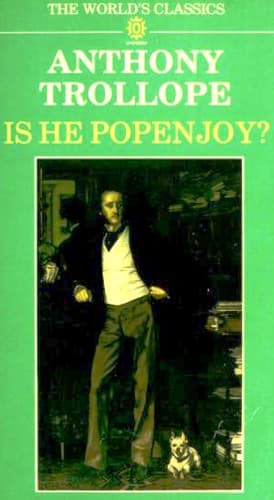
Domestic fiction; Inheritance and succession -- Fiction
Jack, when he had read the letter, tossed it on to the counterpane, and
rolled himself again in bed. It was not as yet much after nine, and he
need not decide for an hour or two whether he would accept the
invitation or not. But the letter bothered him and he could not sleep.
She told him that if he did not come he would be a coward, and he felt
that she had told him the truth. He did not want to see her,--not
because he was tired of her, for in her softer humours she was always
pleasant to him,--but because he had a clear insight into the misery of
the whole connection. When the idea of marrying her suggested itself,
he always regarded it as being tantamount to suicide. Were he to be
persuaded to such a step he would simply be blowing his own brains out
because someone else asked him to do so. He had explained all this to
her at various times when suggesting Dantzic, and she had agreed with
him. Then, at that point, his common sense had been better than hers,
and his feeling really higher. "That being so," he had said, "it is
certainly for your advantage that we should part." But this to her had
been as though he were striving to break his own chains and was
indifferent as to her misery. "I can take care of myself," she had
answered him. But he knew that she could not take care of herself. Had
she not been most unwise, most imprudent, she would have seen the
wisdom of letting the intimacy of their acquaintance drop without any
further explanation. But she was most unwise. Nevertheless, when she
accused him of cowardice, must he not go?
He breakfasted uncomfortably, trying to put off the consideration, and
then uncomfortably sauntered down to the Guard House, at St. James's.
He had no intention of writing, and was therefore not compelled to make
up his mind till the hour named for the appointment should actually
have come. He thought for a while that he would write her a long
letter, full of good sense; explaining to her that it was impossible
that they should be useful to each other, and that he found himself
compelled, by his regard for her, to recommend that their peculiar
intimacy should be brought to an end. But he knew that such a letter
would go for nothing with her,--that she would regard it simply as an
excuse on his part. They two had tacitly agreed not to be bound by
common sense,--not to be wise. Such tacit agreements are common enough
between men, between women, and between men and women. What! a sermon
from you! No indeed; not that. Jack felt all this,--felt that he could
not preach without laying himself open to ridicule. When the time came
he made up his mind that he must go. Of course it was very bad for her.
The servants would all know it. Everybody would know it. She was
throwing away every chance she had of doing well for herself. But what
was he to do? She told him that he would be a coward, and he at any
rate could not bear that.
Public-domain text, read in full here on John Shaqi.
Reviews
Reviews
No reviews yet
Be the first to share your thoughts on this work.
Elsewhere in the archive
Join the Discussion
Join the discussion
Sign in to leave a comment or review.
Sign InorCreate an account