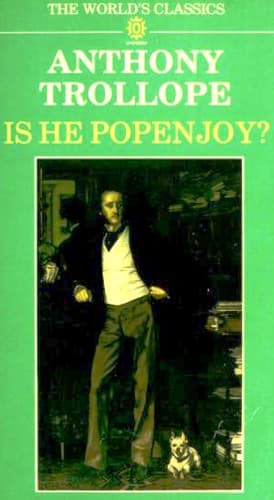
Domestic fiction; Inheritance and succession -- Fiction
"Of course I feel. I have had something to do with my life, and I have
done this with it! Two men have honoured me with their choice, and out
of the two I have chosen--Mr. Houghton. I comfort myself by telling
myself that I did right;--and I did do right. But the comfort is not
very comforting." Still he sat looking at the fire. He knew that it was
open to him to get up and swear to her that she still had his heart.
She could not be angry with him as she had said as much to himself. And
he almost believed at the moment that it was so. He was quite alive to
the attraction of the wickedness, though, having a conscience, he was
aware that the wickedness should, if possible, be eschewed. There is no
romance in loving one's own wife. The knowledge that it is a duty
deadens the pleasure. "I did not mean to say all this," she exclaimed
at last, sobbing.
"Adelaide!" he said.
"Do you love me? You may love me without anything wrong."
"Indeed I do." Then there was an embrace, and after that he hurried
away, almost without another word.
CHAPTER XIX.
RATHER "BOISTEROUS."
"After all, he's very dreary!" It was this that Adelaide Houghton spoke
to herself as soon as Lord George had left her. No doubt the whole work
of the interview had fallen on to her shoulders. He had at last been
talked into saying that he loved her, and had then run away frightened
by the unusual importance and tragic signification of his own words.
"After all, he's very dreary."
Mrs. Houghton wanted excitement. She probably did like Lord George as
well as she liked any one. Undoubtedly she would have married him had
he been able to maintain her as she liked to be maintained. But, as he
had been unable, she had taken Mr. Houghton without a notion on her
part of making even an attempt to love him. When she said that she
could not afford to wear a heart,--and she had said so to various
friends and acquaintances,--she did entertain an idea that
circumstances had used her cruelly, that she had absolutely been forced
to marry a stupid old man, and that therefore some little freedom was
due to her as a compensation. Lord George was Lord George, and might,
possibly, some day be a marquis. He was at any rate a handsome man, and
he had owned allegiance to her before he had transferred his homage to
that rich little chit Mary Lovelace. She was incapable of much passion,
but she did feel that she owed it to herself to have some revenge on
Mary Lovelace. The game as it stood had charms sufficient to induce her
to go on with it; and yet,--after all, he was dreary.
Public-domain text, read in full here on John Shaqi.
Reviews
Reviews
No reviews yet
Be the first to share your thoughts on this work.
Elsewhere in the archive
Join the Discussion
Join the discussion
Sign in to leave a comment or review.
Sign InorCreate an account