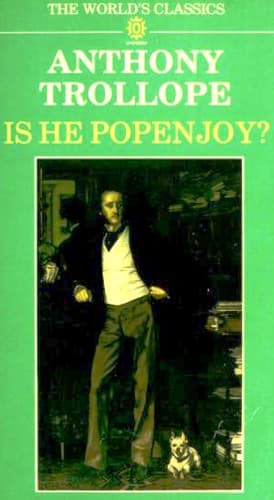
Domestic fiction; Inheritance and succession -- Fiction
so, the only enduring effect of such a feeling was a renewal of that
oft-made resolution that she would be in love with her husband. The
ladies whom she knew had generally their carriages and riding horses.
She had only a brougham, and had that kept for her by the generosity of
her father. The Dean, when coming to town, had brought with him the
horse which she used to ride, and wished that it should remain. But
Lord George, with a husband's solicitude, and perhaps with something of
a poor man's proper dislike to expensive habits, had refused his
permission. She soon, too, learned to know the true sheen of diamonds,
the luxury of pearls, and the richness of rubies; whereas she herself
wore only the little ornaments which had come from the deanery. And as
she danced in spacious rooms and dined in noble halls, and was fêted on
grand staircases, she remembered what a little place was the little
house in Munster Court, and that she was to stay there only for a few
weeks more before she was taken to the heavy dulness of Cross Hall. But
still she always came back to that old resolution. She was so
flattered, so courted, so petted and made much of, that she could not
but feel that had all this world been opened to her sooner her destiny
would probably have been different;--but then it might have been
different, and very much less happy. She still told herself that she
was sure that Lord George was all that he ought to be.
Two or three things did tease her certainly. She was very fond of
balls, but she soon found that Lord George disliked them as much, and
when present was always anxious to get home. She was a married woman,
and it was open to her to go alone; but that she did not like, nor
would he allow it. Sometimes she joined herself to other parties. Mrs.
Houghton was always ready to be her companion, and old Mrs. Montacute
Jones, who went everywhere, had taken a great liking to her. But there
were two antagonistic forces, her husband and herself, and of course
she had to yield to the stronger force. The thing might be managed
occasionally,--and the occasion was no doubt much the pleasanter
because it had to be so managed,--but there was always the feeling that
these bright glimpses of Paradise, these entrances into Elysium, were
not free to her as to other ladies. And then one day, or rather one
night, there came a great sorrow,--a sorrow which robbed these
terrestrial Paradises of half their brightness and more than half their
joy. One evening he told her that he did not like her to waltz. "Why?"
she innocently asked. They were in the brougham, going home, and she
had been supremely happy at Mrs. Montacute Jones's house. Lord George
said that he could hardly explain the reason. He made rather a long
speech, in which he asked her whether she was not aware that many
married women did not waltz. "No," said she. "That is, of course, when
they get old they don't." "I am sure," said he, "that when I say I do
Public-domain text, read in full here on John Shaqi.
Reviews
Reviews
No reviews yet
Be the first to share your thoughts on this work.
Elsewhere in the archive
Join the Discussion
Join the discussion
Sign in to leave a comment or review.
Sign InorCreate an account