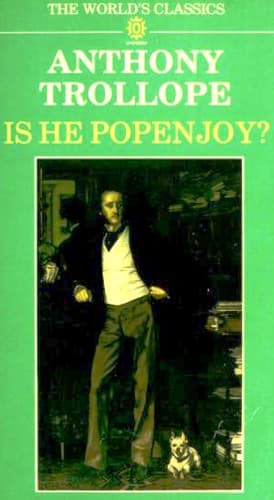
Domestic fiction; Inheritance and succession -- Fiction
"It is a very serious annoyance, certainly, that my own brother and
sisters should turn against me, and give me all this trouble because I
have chosen to marry a foreigner. It is simply an instance of that
pigheaded English blindness which makes us think that everything
outside our own country is or ought to be given up to the devil. My
sisters are very religious, and, I daresay, very good women. But they
are quite willing to think that I and my wife ought to be damned
because we talk Italian, and that my son ought to be disinherited
because he was not baptised in an English church. They have got this
stupid story into their heads, and they must do as they please about
it. I will have no hand in it. I will take care that there shall be no
difficulty in my son's way when I die."
"That will be right, of course, my Lord."
"I know where all this comes from. My brother, who is an idiot, has
married the daughter of a vulgar clergyman, who thinks in his ignorance
that he can make his grandson, if he has one, an English nobleman.
He'll spend his money and he'll burn his fingers, and I don't care how
much money he spends or how much he burns his hands. I don't suppose
his purse is so very long but that he may come to the bottom of it."
This was nearly all that passed between Mr. Stokes and the Marquis. Mr.
Stokes then went back to town and gave Mr. Battle to understand that
nothing was to be done on their side.
The Dean was very anxious that the confidential clerk should be
dispatched, and at one time almost thought that he would go himself.
"Better not, Mr. Dean. Everybody would know," said Mr. Battle.
"And I should intend everybody to know," said the Dean. "Do you suppose
that I am doing anything that I'm ashamed of."
"But being a dignitary----" began Mr. Battle.
"What has that to do with it? A dignitary, as you call it, is not to
see his child robbed of her rights. I only want to find the truth, and
I should never take shame to myself in looking for that by honest
means." But Mr. Battle prevailed, persuading the Dean that the
confidential clerk, even though he confined himself to honest means,
would reach his point more certainly than a Dean of the Church of
England.
But still there was delay. Mr. Stokes did not take his journey down to
Brotherton quite as quickly as he perhaps might have done, and then
there was a prolonged correspondence carried on through an English
lawyer settled at Leghorn. But at last the man was sent. "I think we
know this," said Mr. Battle to the Dean on the day before the man
started, "there were certainly two marriages. One of them took place as
much as five years ago, and the other after his lordship had written to
his brother."
"Then the first marriage must have been nothing," said the Dean.
"It does not follow. It may have been a legal marriage, although the
parties chose to confirm it by a second ceremony."
"But when did the man Luigi die?"
Public-domain text, read in full here on John Shaqi.
Reviews
Reviews
No reviews yet
Be the first to share your thoughts on this work.
Elsewhere in the archive
Join the Discussion
Join the discussion
Sign in to leave a comment or review.
Sign InorCreate an account