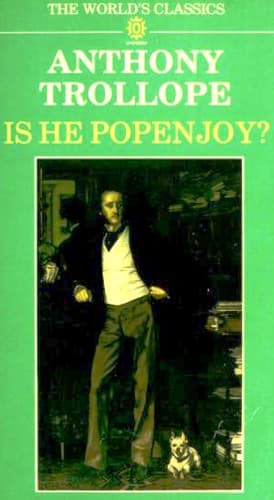
Domestic fiction; Inheritance and succession -- Fiction
"Dearest George;--" When she read the epithet, which she and she only
was entitled to use, she paused for a moment and all the blood rushed
up into her face. She had known the handwriting instantly, and at the
first shock she put the paper down upon the table. For a second there
was a feeling prompting her to read no further. But it was only for a
second. Of course she would read it. It certainly never would have
occurred to her to search her husband's clothes for letters. Up to this
moment she had never examined a document of his except at his bidding
or in compliance with his wish. She had suspected nothing, found
nothing, had entertained not even any curiosity about her husband's
affairs. But now must she not read this letter to which he himself had
directed her? Dearest George! And that in the handwriting of her
friend,--her friend!--Adelaide Houghton;--in the handwriting of the
woman to whom her husband had been attached before he had known
herself! Of course she read the letter.
"DEAREST GEORGE,--
"I break my heart when you don't come to me; for heaven's sake be
here to-morrow. Two, three, four, five, six, seven--I shall be
here any hour till you come. I don't dare to tell the man that I
am not at home to anybody else, but you must take your chance.
Nobody ever does come till after three or after six. He never
comes home till half-past seven. Oh me! what is to become of me
when you go out of town? There is nothing to live for,
nothing;--only you. Anything that you write is quite safe. Say
that you love me. A."
The letter had grieved him when he got it,--as had other letters before
that. And yet it flattered him, and the assurance of the woman's love
had in it a certain candied sweetness which prevented him from
destroying the paper instantly, as he ought to have done. Could his
wife have read all his mind in the matter her anger would have been
somewhat mollified. In spite of the candied sweetness he hated the
correspondence. It had been the woman's doing and not his. It is so
hard for a man to be a Joseph! The Potiphar's wife of the moment has
probably had some encouragement,--and after that Joseph can hardly flee
unless he be very stout indeed. This Joseph would have fled, though
after a certain fashion he liked the woman, had he been able to assure
himself that the fault had in no degree been his. But looking back, he
thought that he had encouraged her, and did not know how to fly. Of all
this Mary knew nothing. She only knew that old Mr. Houghton's wife, who
professed to be her dear friend, had written a most foul love-letter to
her husband, and that her husband had preserved it carefully, and had
then through manifest mistake delivered it over into her hands.
Public-domain text, read in full here on John Shaqi.
Reviews
Reviews
No reviews yet
Be the first to share your thoughts on this work.
Elsewhere in the archive
Join the Discussion
Join the discussion
Sign in to leave a comment or review.
Sign InorCreate an account