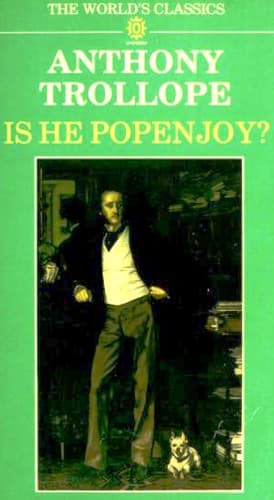
Domestic fiction; Inheritance and succession -- Fiction
So it came to pass that Lord George went down to Cross Hall in the
morning and that Mary accompanied her father to the deanery the same
afternoon. The Dean had already learned that it would be well that he
should face his clerical enemies as soon as possible. He had already
received a letter worded in friendly terms from the Bishop, asking him
whether he would not wish to make some statement as to the occurrence
at Scumberg's Hotel which might be made known to the clergymen of the
Cathedral. He had replied by saying that he wished to make no such
statement, but that on his return to Brotherton he would be very
willing to tell the Bishop the whole story if the Bishop wished to hear
it. He had been conscious of Mr. Groschut's hand even among the civil
phrases which had come from the Bishop himself. "In such a matter," he
said in his reply, "I am amenable to the laws of the land, and am not,
as I take it, amenable to any other authority." Then he went on to say
that for his own satisfaction he should be very glad to tell the story
to the Bishop.
The story as it reached Brotherton had, no doubt, given rise to a great
deal of scandal and a great deal of amusement. Pountner and Holdenough
were to some extent ashamed of their bellicose Dean. There is something
ill-mannered, ungentlemanlike, what we now call rowdy, in personal
encounters, even among laymen,--and this is of course aggravated when
the assailant is a clergyman. And these canons, though they kept up
pleasant, social relations with the Dean, were not ill-disposed to
make use of so excellent a weapon against a man, who, though coming
from a lower order than themselves, was never disposed in any way to
yield to them. But the two canons were gentlemen, and as gentlemen were
gracious. Though they liked to have the Dean on the hip, they did not
want to hurt him sorely when they had gotten him there. They would be
contented with certain sly allusions, and only half-expressed triumphs.
But Mr. Groschut was confirmed in his opinion that the Dean was
altogether unfit for his position,--which, for the interests of the
Church, should be filled by some such man as Mr. Groschut himself, by
some God-fearing clergyman, not known as a hard rider across country
and as a bruiser with his fists. There had been an article in the
"Brotherton Church Gazette," in which an anxious hope was expressed
that some explanation would be given of the very incredible tidings
which had unfortunately reached Brotherton. Then Mr. Groschut had
spoken a word in season to the Bishop. Of course he said it could not
be true; but would it not be well that the Dean should be invited to
make his own statement? It was Mr. Groschut who had himself used the
word "incredible" in the article. Mr. Groschut, in speaking to the
Bishop, said that the tidings must be untrue. And yet he believed and
rejoiced in believing every word of them. He was a pious man, and did
not know that he was lying. He was an anxious Christian, and did not
Public-domain text, read in full here on John Shaqi.
Reviews
Reviews
No reviews yet
Be the first to share your thoughts on this work.
Elsewhere in the archive
Join the Discussion
Join the discussion
Sign in to leave a comment or review.
Sign InorCreate an account