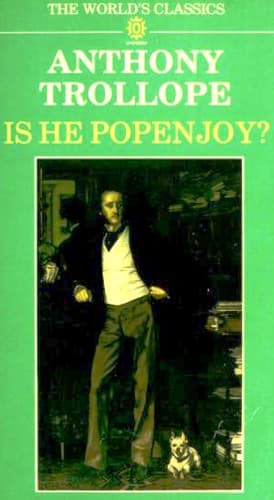
Domestic fiction; Inheritance and succession -- Fiction
He had learnt that Miss Houghton's story was true, and was certainly
very unhappy. It was not at all that he had pictured to himself the
glory of being himself the Marquis of Brotherton after his brother's
death; nor was it only the disappointment which he felt as to any
possible son of his own, though on that side he did feel the blow. The
reflection which perplexed him most was the consciousness that he must
quarrel with his brother, and that after such a quarrel he would become
nobody in the world. And then, added to this, was the sense of family
disgrace. He would have been quite content with his position had he
been left master of the house at Manor Cross, even without any of his
brother's income wherewith to maintain the house. But now he would only
be his wife's husband, the Dean's son-in-law, living on their money,
and compelled by circumstances to adapt himself to them. He almost
thought that had he known that he would be turned out of Manor Cross,
he would not have married. And then, in spite of his disclaimer to Mr.
Knox, he was already suspicious of some foul practise. An heir to the
title and property, to all the family honours of the Germains, had
suddenly burst upon him, twelve months,--for aught that he knew, two or
three years,--after the child's birth! Nobody had been informed when
the child was born, or in what circumstances,--except that the mother
was an Italian widow! What evidence on which an Englishman might rely
could possibly be forthcoming from such a country as Italy! Poor Lord
George, who was himself as honest as the sun, was prepared to believe
all evil things of people of whom he knew nothing! Should his brother
die,--and his brother's health was bad,--what steps should he take?
Would it be for him to accept this Italian brat as the heir to
everything, or must he ruin himself by a pernicious lawsuit? Looking
forward he saw nothing but family misery and disgrace, and he saw,
also, inevitable difficulties with which he knew himself to be
incapable to cope. "It is true," he said to his wife very gloomily,
when he first met her after his interview with Mr. Knox.
"What Miss Houghton said? I felt sure it was true, directly she told
me."
"I don't know why you should have felt sure, merely on her word, as to
a thing so monstrous as this is. You don't seem to see that it concerns
yourself."
"No; I don't. It doesn't concern me at all, except as it makes you
unhappy." Then there was a pause for a moment, during which she crept
close up to him, in a manner that had now become usual with her. "Why
do you think I married you?" she said. He was too unhappy to answer her
pleasantly,--too much touched by her sweetness to answer her
unpleasantly; and so he said nothing. "Certainly not with any hope that
I might become Marchioness of Brotherton. Whatever may have made me do
such a thing, I can assure you that that had nothing to do with it."
Public-domain text, read in full here on John Shaqi.
Reviews
Reviews
No reviews yet
Be the first to share your thoughts on this work.
Elsewhere in the archive
Join the Discussion
Join the discussion
Sign in to leave a comment or review.
Sign InorCreate an account