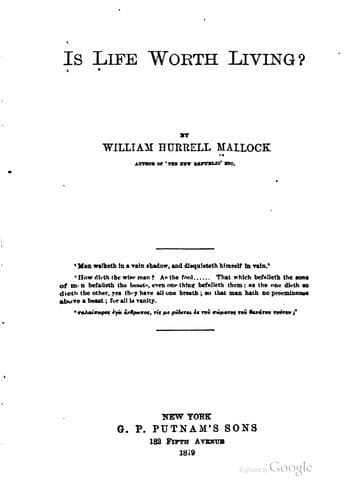
Is Life Worth Living?Mallock, W. H. (William Hurrell)
Philosophy
Is Life Worth Living?
Mallock, W. H. (William Hurrell)
Ethics; Life
We have but to state the matter in terms of common life, to see how
impossible is the only condition of things that would make the positive
system practicable. The first wonder that suggests itself, is how so
grotesque a conception could ever have originated. But its genesis is
not far to seek. The positivists do not postulate any new elements in
human nature, but the reduction of some, elimination of others, and the
magnifying of others. And they actually find cases where this process
has been effected. But they quite forget the circumstances that have
made such an event possible. They forget that in their very nature they
have been altogether exceptional and transitory; and that it is
impossible to construct a Utopia in which they shall exist at all. We
can, for instance, no doubt point to Leonidas and the three hundred as
specimens of what human heroism can rise to; and we can point to the
Stoics as specimens of human self-control. But to make a new Thermopylae
we want a new Barbarian; and before we can recoil from temptation as the
Stoics did, we must make pleasure as perilous and as terrible as it was
under the Roman emperors. Such developments of humanity are at their
very essence abnormal; and to suppose that they could ever become the
common type of character, would be as absurd as to suppose that all
mankind could be kings. I will take another instance that is more to the
point yet. A favourite positivist parable is that of the miser. The
miser in the first place desires gold because it can buy pleasure. Next
he comes to desire it more than the pleasure it can buy. In the same
way, it is said, men can be taught to desire virtue by investing it with
the attractions of the end, to which, strictly speaking it is no more
than the means. But this parable really disproves the very possibility
it is designed to illustrate. It is designed to illustrate the
possibility of our choosing actions that will give pleasure to others,
in contradistinction to actions that will give pleasure to ourselves.
But the miser desires gold for an exactly opposite reason. He desires it
as potential selfishness, not as potential philanthropy. Secondly, we
are to choose the actions in question because they will make us happy.
But the very name we give the miser shows that the analogous choice in
his case makes him miserable. Thirdly, the material miser is an
exceptional character; there is no known means by which it can be made
more common; and with the moral miser the case will be just the same.
Lastly, if such a character be barely producible even in the present
state of the world, much less will it be producible when human
capacities shall have been curtailed by positivism, when the pleasures
that the gold of virtue represents are less intense than at present, and
the value of the coveted coin is indefinitely depreciated.
Public-domain text, read in full here on John Shaqi.
Reviews
Reviews
No reviews yet
Be the first to share your thoughts on this work.
Elsewhere in the archive
Join the Discussion
Join the discussion
Sign in to leave a comment or review.
Sign InorCreate an account