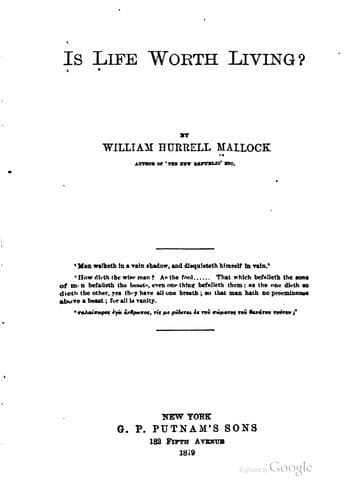
Is Life Worth Living?Mallock, W. H. (William Hurrell)
Philosophy
Is Life Worth Living?
Mallock, W. H. (William Hurrell)
Ethics; Life
If we will but think all this calmly over, and try really to sympathise
with the position of these poor enthusiasts, we shall soon see their
system in its true light, and shall learn at once to realise and to
excuse its fatuity. We shall see that it either has no meaning whatever,
or that its meaning is one that its authors have already repudiated, and
only do not recognise now, because they have so inadequately
re-expressed it. We shall see that their system has no motive power at
all in it, or that its motive power is simply the theistic faith they
rejected, now tied up in a sack and left to flounder instead of walking
upright. We shall see that their system is either nothing, or that it is
a mutilated reproduction of the very thing it professes to be
superseding. Once set it upon its own professed foundations, and the
entire quasi-religious structure, with its visionary hopes, its
impossible enthusiasms--all its elaborate apparatus for enlarging the
single life, and the generation that surrounds it, falls to earth
instantly like a castle of cards. We are left simply each of us with our
own lives, and with the life about us, amplified indeed to a certain
extent by sympathy, but to a certain extent only--an extent whose limits
we are quite familiar with from experience, and which positivism, if it
tends to move them at all, can only narrow, and can by no possibility
extend. We are left with this life, changed only in one way. It will
have nothing added to it, but it will have much taken from it.
Everything will have gone that is at present keenest in it--joys and
miseries as well. In this way positivism is indeed an engine of change,
and may inaugurate if not complete a most momentous kind of progress.
That progress is the gradual de-religionizing of life, the slow
sublimating out of it of its concrete theism--the slow destruction of
its whole moral civilisation. And as this progress continues there will
not only fade out of the human consciousness the things I have before
dwelt on--all capacity for the keener pains and pleasures, but there
will fade out of it also that strange sense which is the union of all
these--the white light woven of all these rays; that is, the vague but
deep sense of some special dignity in ourselves--a sense which we feel
to be our birthright, inalienable except by our own act and deed; a
sense which, at present, in success sobers us, and in failure sustains
us, and which is visible more or less distinctly in our manners, in our
bearing, and even in the very expression of the human countenance: it
is, in other words, the sense that life is worth living, not
accidentally but essentially. And as this sense goes its place will be
taken by one precisely opposite--the sense that life, in so far as it is
worth living at all, is worth living not essentially, but accidentally;
that it depends entirely upon what of its pleasures we can each one of
us realise; that it will vary as a positive quantity, like wealth, and
Public-domain text, read in full here on John Shaqi.
Reviews
Reviews
No reviews yet
Be the first to share your thoughts on this work.
Elsewhere in the archive
Join the Discussion
Join the discussion
Sign in to leave a comment or review.
Sign InorCreate an account