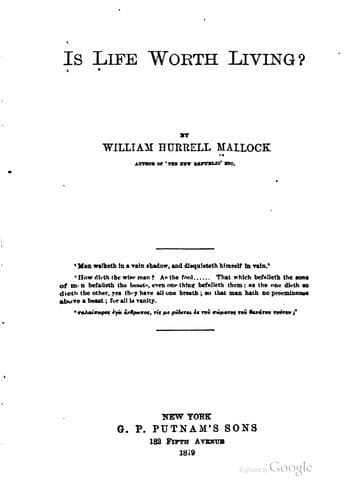
Is Life Worth Living?Mallock, W. H. (William Hurrell)
Philosophy
Is Life Worth Living?
Mallock, W. H. (William Hurrell)
Ethics; Life
Dr. Johnson said that these verses were the noblest in English poetry.
Could he have read them in our day, and have realised with what a
pitiful accuracy their prophecy might soon begin to fulfil itself, he
would probably have been too busy with dissatisfaction at the matter of
it to have any time to spare for an artistic approbation of the manner.
FOOTNOTES:
[27] Mr. Frederic Harrison.
[28] The case of J.S. Mill may seem at first sight to be an exception to
this. But it is really not so. Though he was brought up without any
religious teaching, yet the severe and earnest influences of his
childhood would have been impossible except in a religious country. He
was in fact brought up in an atmosphere (if I may borrow with a slight
change a phrase of Professor Huxley's) of Puritanism minus Christianity.
It may be remembered farther that Mill says of himself, '_I am one of
the very few examples of one who has not thrown off religious belief,
but never had it_.'
CHAPTER VIII.
THE PRACTICAL PROSPECT.
_Not from the stars do I my judgment pluck....
Nor can I fortune to brief minutes tell._
Shakespeare, _Sonnet XIV_.
The prospects I have been just describing as the goal of positive
progress will seem, no doubt, to many to be quite impossible in its
cheerlessness. If the future glory of our race was a dream, not worth
dwelling on, much more so, they will say, is such a future abasement of
it as this. They will say that optimism may at times have perhaps been
over-sanguine, but that this was simply the exuberance of health;
whereas pessimism is, in its very nature, the gloom and languor of a
disease.
Now with much of this view of the matter I entirely agree. I admit that
the prospect I have described may be an impossible one; personally, I
believe it is so. I admit also that pessimism is the consciousness of
disease, confessing itself. But the significance of these admissions is
the very opposite of what it is commonly supposed to be. They do not
make the pessimism I have been arguing one whit less worthy of
attention; on the contrary, they make it more worthy. This is the point
on which I may most readily be misunderstood. I will therefore try to
make my meaning as clear as possible.
Pessimism, then, represents, to the popular mind, a philosophy or view
of life the very name of which is enough to condemn it. The popular
mind, however, overlooks one important point. Pessimism is a vague word.
It does not represent one philosophy, but several; and before we, in any
case, reject its claims on our attention, we should take care to see
what its exact meaning is.
Public-domain text, read in full here on John Shaqi.
Reviews
Reviews
No reviews yet
Be the first to share your thoughts on this work.
Elsewhere in the archive
Join the Discussion
Join the discussion
Sign in to leave a comment or review.
Sign InorCreate an account