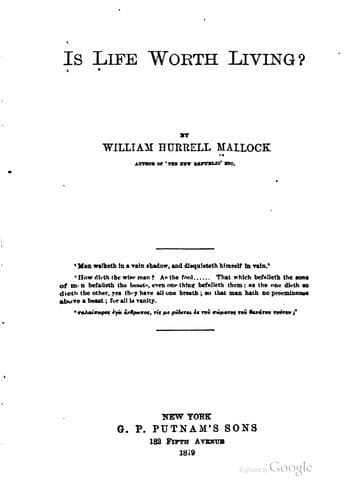
Is Life Worth Living?Mallock, W. H. (William Hurrell)
Philosophy
Is Life Worth Living?
Mallock, W. H. (William Hurrell)
Ethics; Life
To begin, then, let us remember what these men were when Christians; and
we shall be better able to realise what they are now. They were men who
believed firmly in the supreme and solemn importance of life, in the
privilege that it was to live, despite all temporal sorrow. They had a
rule of conduct which would guide them, they believed, to the true end
of their being--to an existence satisfying and excellent beyond anything
that imagination could suggest to them; they had the dread of a
corresponding ruin to fortify themselves in their struggle against the
wrong; and they had a God ever present, to help and hear, and take pity
on them. And yet even thus, selfishness would beset the most unselfish,
and weariness the most determined. How hard the battle was, is known to
all; it has been the most prominent commonplace in human thought and
language. The constancy and the strength of temptation, and the
insidiousness of the arguments it was supported by, has been proverbial.
To explain away the difference between good and evil, to subtly steal
its meaning out of long-suffering and self-denial, and, above all, to
argue that in sinning '_we shall not surely die_,' a work which was
supposed to belong especially to the devil, has been supposed to have
been accomplished by him with a success continually irresistible. What,
then, is likely to be the case now, with men who are still beset with
the same temptations, when not only they have no hell to frighten, no
heaven to allure, and no God to help them; but when all the arguments
that they once felt belonged to the father of lies, are pressed on them
from every side as the most solemn and universal truths? Thus far the
result has been a singular one. With an astonishing vigour the moral
impetus still survives the cessation of the forces that originated and
sustained it; and in many cases there is no diminution of it traceable,
so far as action goes. This, however, is only true, for the most part,
of men advanced in years, in whom habits of virtue have grown strong,
and whose age, position, and circumstances secure them from strong
temptation. To see the real work of positive thought we must go to
younger men, whose characters are less formed, whose careers are still
before them, and on whom temptation of all kinds has stronger hold. We
shall find such men with the sense of virtue equally vivid in them, and
the desire to practise it probably far more passionate; but the effect
of positive thought on them we shall see to be very different.
Public-domain text, read in full here on John Shaqi.
Reviews
Reviews
No reviews yet
Be the first to share your thoughts on this work.
Elsewhere in the archive
Join the Discussion
Join the discussion
Sign in to leave a comment or review.
Sign InorCreate an account