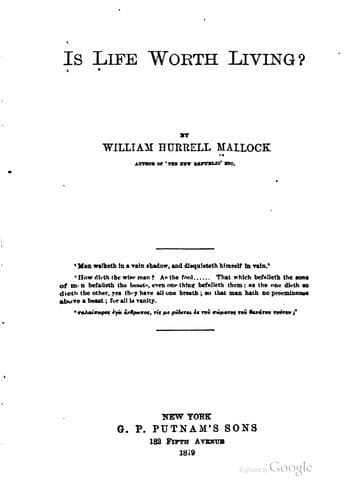
Is Life Worth Living?Mallock, W. H. (William Hurrell)
Philosophy
Is Life Worth Living?
Mallock, W. H. (William Hurrell)
Ethics; Life
And now let us turn again to the case in question. Men of such a
character as I have been just describing may find conscience quite equal
to giving a glow, by its approval, to their virtuous wishes; but they
will find it quite unequal to sustaining them against their vicious
ones; and the more vigorous the intellect of the man, the more feeble
will be the power of conscience. When a man is very strongly tempted to
do a thing which he believes to be wrong, it is almost inevitable that
he will test to the utmost the reasons of this belief; or if he does not
do this before he yields to the temptation, yet if he does happen to
yield to it, he will certainly do so after. Thus, unless we suppose
human nature to be completely changed, and all our powers of observation
completely misleading, the inward condition of the class in question is
this. However calm the outer surface of their lives may seem, under the
surface there is a continual discord; and also, though they alone may
perceive it, a continued decadence. In various degrees they all yield to
temptation; all men in the vigour of their manhood do; and conscience
still fills them with its old monitions and reproaches. But it cannot
enforce obedience. They feel it to be the truth, but at the same time
they know it to be a lie; and though they long to be coerced by it, they
find it cannot coerce them. Reason, which was once its minister, is now
the tribune of their passions, and forbids them, in times of passion,
to submit to it. They are not suffered to forget that it is not what it
says it is, that
_It never came from on high,
And never rose from below_:
and they cannot help chiding themselves with the irrepressible
self-reproach,
_Am I to be overawed
By what I cannot but know,
Is a juggle born of the brain?_
Thus their conscience, though not stifled, is dethroned; it is become a
fugitive Pretender; and that part of them that would desire its
restoration is set down as an intellectual _malignant_, powerless indeed
to restore its sovereign.
_Invalidasque tibi tendens, heu non tua, palmas._
Conscience, in short, as soon as its power is needed, is like their own
selves dethroned within themselves, wringing its hands over a rebellion
it is powerless to suppress. And then, when the storm is over, when the
passions again subside, and their lives once more return to their wonted
channels, it can only come back humbly and dejected, and give them in a
timid voice a faint, dishonoured blessing.
Public-domain text, read in full here on John Shaqi.
Reviews
Reviews
No reviews yet
Be the first to share your thoughts on this work.
Elsewhere in the archive
Join the Discussion
Join the discussion
Sign in to leave a comment or review.
Sign InorCreate an account