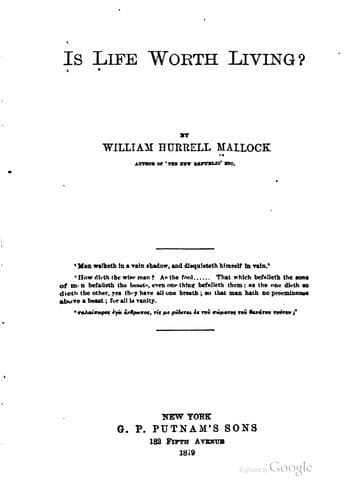
Is Life Worth Living?Mallock, W. H. (William Hurrell)
Philosophy
Is Life Worth Living?
Mallock, W. H. (William Hurrell)
Ethics; Life
Such, then, is the condition of that large and increasing class on which
modern thought is beginning to do its work. Its work must be looked for
here, and not in narrower quarters; not amongst professors and
lecturers, but amongst the busy crowd about us; not on the platforms of
institutions, or in the lay sermons of specialists, but amongst
politicians, artists, sportsmen, men of business, lovers--in '_the tides
of life, and in the storm of action_'--amongst men who have their own
way to force or choose in the world, and their daily balance to strike
between self-denial and pleasure--on whom the positive principles have
been forced as true, and who have no time or talent to do anything else
but live by them. It is amongst these that we must look to see what
such principles really result in; and of these we must choose not those
who would welcome license, but those who long passionately to live by
law. It is the condition of such men that I have been just describing.
Its characteristics are vain self-reproach, joyless commendation, weary
struggle, listless success, general indifference, and the prospect that
if matters are going thus badly with them, they will go even worse with
their children.
Such a spectacle certainly is not one that has much promise for the
optimist; and the more we consider it, the more sad and ominous will it
appear to us. Indeed, when the present age shall realise its own
condition truly, the dejection of which it is slowly growing conscious
may perhaps give way to despair. This condition, however, is so
portentous that it is difficult to persuade ourselves that it is what it
seems to be, and that it is not a dream. But the more steadily we look
at it, the more real will its appalling features appear to us. We are
literally in an age to which history can show no parallel, and which is
new to the experience of humanity; and though the moral dejection we
have been dwelling on may have had many seeming counterparts in other
times, this is, as it were, solid substance, whereas they were only
shadows. I have pointed out already in my first chapter how unexampled
is the state in which the world now finds itself; but we will dwell
once again upon its more general features. Within less than a century,
distance has been all but annihilated, and the earth has practically,
and to the imagination, been reduced to a fraction of its former size.
Its possible resources have become mean and narrow, set before us as
matters of every-day statistics. All the old haze of wonder is melting
away from it; and the old local enthusiasms, which depended so largely
on ignorance and isolation, are melting likewise. Knowledge has
accumulated in a way never before dreamed of. The fountains of the past
seem to have been broken up, and to be pouring all their secrets into
the consciousness of the present. For the first time man's wide and
varied history has become a coherent whole to him. Partly a cause and
Public-domain text, read in full here on John Shaqi.
Reviews
Reviews
No reviews yet
Be the first to share your thoughts on this work.
Elsewhere in the archive
Join the Discussion
Join the discussion
Sign in to leave a comment or review.
Sign InorCreate an account