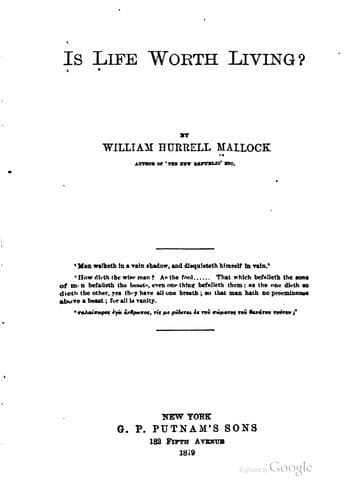
Is Life Worth Living?Mallock, W. H. (William Hurrell)
Philosophy
Is Life Worth Living?
Mallock, W. H. (William Hurrell)
Ethics; Life
If this be really the case, we shall not be able to dispose of
pessimism by calling it a disease; for the disease will be real and
universal, and pessimism will be nothing but the scientific description
of it. The pessimist is only silenced by being called diseased, when it
is meant that the disease imputed to him is either hypochondriacal or
peculiar to himself. But in the present case the disease is real,
deep-seated, and extending steadily. The only question for us is, is it
curable or incurable? This the event alone can answer: but as no future
can be produced but through the agency of the present, the event, to a
certain extent, must be in our own hands. For us, at any rate, the first
thing to be done is to face boldly our own present condition, and the
causes that are producing it. To become alive to our danger is the one
way to escape from it. But the danger is at present felt rather than
known. The class of men we are considering are conscious, as Mr. Matthew
Arnold says, '_of a void that mines the breast_;' but each thinks that
this is a fancy only, and hardly dares communicate it to his fellows.
Here and there, however, by accident, it is already finding unintended
expression; and signs come to the surface of the vague distrust and
misgiving that are working under it. The form it takes amongst the
general masses that are affected by it is, as might be expected,
practical rather than analytical. They are conscious of the loss that
the loss of faith is to them; and more or less coherently they long for
its recovery. Outwardly, indeed, they may often sneer at it; but outward
signs in such matters are very deceiving. Much of the bitter and
arrogant certitude to be found about us in the expression of unbelief,
is really like the bitterness of a woman against her lover, which has
not been the cause of her resolving to leave him, but which has been
caused by his having left her. In estimating what is really the state of
feeling about us, we must not look only at the surface. We must remember
that deep feeling often expresses itself by contradicting itself; also
that it often exists where it is not expressed at all, or where it
betrays rather than expresses itself; and, further, that during the
hours of common intercourse, it tends, for the time being, to disappear.
People cannot be always exclaiming in drawing-rooms that they have lost
their Lord; and the fact may be temporarily forgotten because they have
lost their portmanteau. All serious reflections are like reflections in
water--a pebble will disturb them, and make a dull pond sparkle. But the
sparkle dies, and the reflection comes again. And there are many about
us, though they never confess their pain, and perhaps themselves hardly
like to acknowledge it, whose hearts are aching for the religion that
they can no longer believe in. Their lonely hours, between the intervals
of gaiety, are passed with barren and sombre thoughts; and a cry rises
to their lips but never passes them.
Public-domain text, read in full here on John Shaqi.
Reviews
Reviews
No reviews yet
Be the first to share your thoughts on this work.
Elsewhere in the archive
Join the Discussion
Join the discussion
Sign in to leave a comment or review.
Sign InorCreate an account