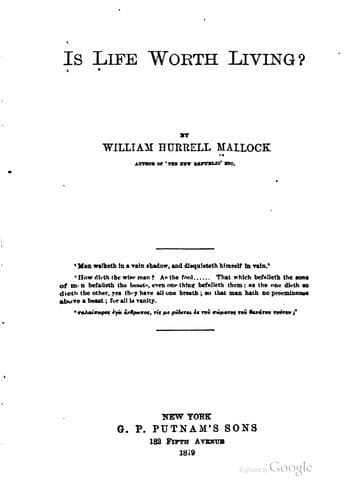
Is Life Worth Living?Mallock, W. H. (William Hurrell)
Philosophy
Is Life Worth Living?
Mallock, W. H. (William Hurrell)
Ethics; Life
affirming that every note we hear in a piece of music has its definite
correlative in the mechanics of the organ, and that it is accompanied by
a depression and a rising again of some particular key. In his views
thus far the whole world may agree with him; whilst when he adds so
emphatically that in these views there is still involved a mystery, we
shall not so much say that the world agrees with him as that he, like a
good sensible man, agrees with the world. The passage from mind to
matter is, Dr. Tyndall says, unthinkable. The common sense of mankind
has always said the same. We have here a something, not which we are
doubtful how to explain, but which we cannot explain at all. We have not
to choose or halt between alternative conjectures, for there are
absolutely no conjectures to halt between. We are now, as to this point,
in the same state of mind in which we have always been, only this state
of mind has been revealed to us more clearly. We are in theoretical
ignorance, but we are in no practical perplexity.
The perplexity comes in with the second question; and it is here that
the issue lies between the affirmation and the denial of a second and a
supernatural order. We will see, first, how this question is put and
treated by Dr. Tyndall, and we will then see what his treatment comes
to. Is it true, he asks, as many physicists hold it is, '_that the
physical processes are complete in themselves, and would go on just as
they do if consciousness were not at all implicated_,' as an engine
might go on working though it made no noise, or as a barrel-organ might
go on playing even though there were no ear to listen to it? Or do
'_states of consciousness enter as links into the chain of antecedence
and sequence which gives rise to bodily actions?_' Such is the question
in Dr. Tyndall's own phrases; and here, in his own phrases also, comes
his answer. '_I have no power_,' he says, '_of imagining such states
interposed between the molecules of the brain, and influencing the
transference of motion among the molecules. The thing_ eludes all mental
presentation. _But_,' he adds, '_the production of consciousness by
molecular motion is quite as unpresentable to the mental vision as the
production of molecular motion by consciousness. If I reject one result,
I reject both. I, however, reject neither, and thus stand in the
presence of two Incomprehensibles, instead of one Incomprehensible._'
Public-domain text, read in full here on John Shaqi.
Reviews
Reviews
No reviews yet
Be the first to share your thoughts on this work.
Elsewhere in the archive
Join the Discussion
Join the discussion
Sign in to leave a comment or review.
Sign InorCreate an account