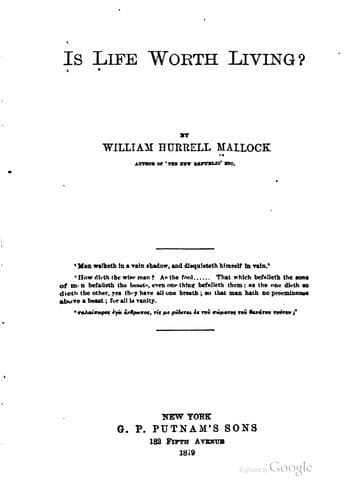
Is Life Worth Living?Mallock, W. H. (William Hurrell)
Philosophy
Is Life Worth Living?
Mallock, W. H. (William Hurrell)
Ethics; Life
From these difficulties it is impossible to escape. All we can do here,
as in the former case, is to show that they are not peculiar to the
special doctrines to which they are supposed generally to be due; but
that they are equally inseparable from any of the proposed substitutes.
We can only show that they are inevitable, not that they are not
insoluble. If we condemn a belief in heaven because it is unthinkable,
we must for the same reason, as we have seen already, condemn a Utopia
on earth--the thing we are now told we should fix our hopes upon,
instead of it. As to the second question--that of eternal punishment, we
may certainly here get rid of one difficulty by adopting the doctrine of
a final restitution. But, though one difficulty will be thus got rid of,
another equally great will take its place. Our moral sense, it is true,
will no more be shocked by the conception of an eternal discord in
things, but we shall be confronted by a fatalism that will allow to us
no moral being at all. If we shall all reach the same place in the
end--if inevitably we shall all do so--it is quite plain that our
freedom to choose in the matter is a freedom that is apparent only. Mr.
Leslie Stephen, it seems, sees this clearly enough. Once give morality
its spiritual and supernatural meaning, and there is, he holds, '_some
underlying logical necessity which binds_ [a belief in hell]
_indissolubly with the primary articles of the faith_.' Such a system of
retribution, he adds, is '_created spontaneously_' by the '_conscience.
Heaven and hell are corollaries that rise and fall together.... Whatever
the meaning of [Greek: aionios], the_ fearful _emotion which is
symbolised, is eternal or independent of time, by the same right as the_
ecstatic _emotion_.' He sees this clearly enough; but the strange thing
is that he does not see the converse. He sees that the Christian
conception of morality necessitates the affirmation of hell. He does not
see that the denial of hell is the denial of Christian morality, and
that in calling the former a dream, as he does, he does not call the
latter a dream likewise.
We can close our eyes to none of these perplexities. The only way to
resist their power is not to ignore them, but to realise to the full
their magnitude, and to see how, if we let them take away from us
anything, they will in another moment take everything; to see that we
must either set our foot upon their necks, or that they will set their
feet on ours; to see that we can look them down, but that we can never
look them through; to see that we can make them impotent if we will, but
that if they are not impotent they will be omnipotent.
Public-domain text, read in full here on John Shaqi.
Reviews
Reviews
No reviews yet
Be the first to share your thoughts on this work.
Elsewhere in the archive
Join the Discussion
Join the discussion
Sign in to leave a comment or review.
Sign InorCreate an account