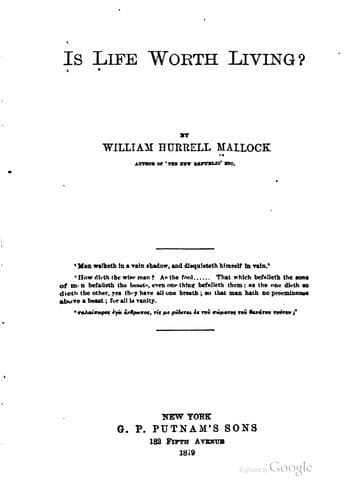
Is Life Worth Living?Mallock, W. H. (William Hurrell)
Philosophy
Is Life Worth Living?
Mallock, W. H. (William Hurrell)
Ethics; Life
Such is free-will when looked at from a distance. But let us look at it
more closely, and see what happens then. The result is strange. Like a
path seen at dusk across a moorland, plain and visible from a distance,
but fading gradually from us the more near we draw to it, so does the
belief in free-will fade before the near inspection of reason. It at
first grows hazy; at last it becomes indistinguishable. At first we
begin to be uncertain of what we mean by it; at last we find ourselves
certain that so far as we trust to reason, we cannot possibly have any
meaning at all. Examined in this way, every act of our lives--all our
choices and refusals, seem nothing but the necessary outcome of things
that have gone before. It is true that between some actions the choice
hangs at times so evenly, that our _will_ may seem the one thing that at
last turns the balance. But let us analyse the matter a little more
carefully, and we shall see that there are a thousand microscopic
motives, too small for us to be entirely conscious of, which, according
to how they settle on us, will really decide the question. Nor shall we
see only that this is so. Let us go a little further, and reason will
tell us that it must be so. Were this not the case, there would have
been an escape left for us. Though admitting that what controlled our
actions could be nothing but the strongest motive, it might yet be
contended that the will could intensify any motive it chose, and that
thus motives really were only tools in its hands. But this does but
postpone the difficulty, not solve it. What is this free-will when it
comes to use its tools? It is a something, we shall find, that our minds
cannot give harbour to. It is a thing contrary to every analogy of
nature. It is a thing which is forever causing, but which is in itself
uncaused.
To escape from this difficulty is altogether hopeless. Age after age has
tried to do so, but tried in vain. There have been always metaphysical
experts ready to engage to make free-will a something intellectually
conceivable. But they all either leave the question where they found
it, or else they only seem to explain it, by denying covertly the fact
that really wants explaining.
Such is free-will when examined by the natural reason--a thing that
melts away inevitably first to haze, and then to utter nothingness. And
for a time we feel convinced that it really is nothing. Let us, however,
again retire from it to the common distance, and the phantom we thought
exorcised is again back in an instant. There is the sphinx once more,
distinct and clear as ever, holding in its hand the scales of good and
evil, and demanding a curse or a blessing for every human action. We are
once more certain--more certain of this than anything--that we are, as
we always thought we were, free agents, free to choose, and free to
refuse; and that in virtue of this freedom, and in virtue of this alone,
we are responsible for what we do and are.
Public-domain text, read in full here on John Shaqi.
Reviews
Reviews
No reviews yet
Be the first to share your thoughts on this work.
Elsewhere in the archive
Join the Discussion
Join the discussion
Sign in to leave a comment or review.
Sign InorCreate an account