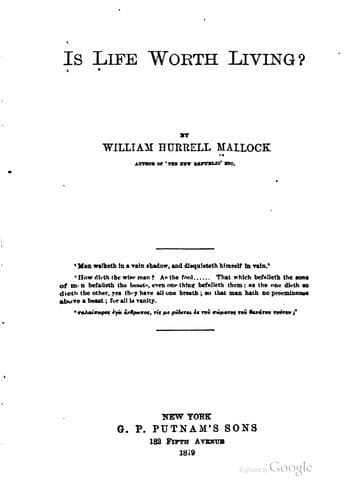
Is Life Worth Living?Mallock, W. H. (William Hurrell)
Philosophy
Is Life Worth Living?
Mallock, W. H. (William Hurrell)
Ethics; Life
Before going further with this question it will be well to say a few
words as to the exact position it occupies. This, with regard to the
needs of man, is somewhat different to the position of natural theism.
That a natural theism is essential to man's moral being is a proposition
that can be more or less rigidly demonstrated; but that a revelation is
essential as a supplement to natural theism can be impressed upon us
only in a much looser way. Indeed, many men who believe most firmly that
without religion human life will be dead, rest their hopes for the
future not on the revival and triumph of any one alleged revelation, but
on the gradual evanescence of the special claims of all. Nor can we find
any sharp and defined line of argument to convince them that they are
wrong. The objections, however, to which this position is open are, I
think, none the less cogent because they are somewhat general; and to
all practical men, conversant with life and history, it must be plain
that the necessity of doing God's will being granted, it is a most
anxious and earnest question whether that will has not been in some
special and articulate way revealed to us.
Take the mass of religious humanity, and giving it a natural creed, it
will be found that instinctively and inevitably it asks for more. Such a
creed by itself has excited more longings than it has satisfied, and
raised more perplexities than it has set at rest. It is true that it
has supplied men with a sufficient analysis of the worth they attach to
life, and of the momentous issues attendant on the way in which they
live it. But when they come practically to choose their way, they find
that such religion is of little help to them. It never puts out a hand
to lift or lead them. It is an alluring voice, heard far off through a
fog, and calling to them, '_Follow me!_' but it leaves them in the fog
to pick their own way out towards it, over rocks and streams and
pitfalls, which they can but half distinguish, and amongst which they
may be either killed or crippled, and are almost certain to grow
bewildered. And even should there be a small minority, who feel that
this is not true of themselves, they can hardly help feeling that it is
true of the world in general. A purely natural theism, with no organs of
human speech, and with no machinery for making its spirit articulate,
never has ruled men, and, so far as we can see, never possibly can rule
them. The choices which our life consists of are definite things. The
rule which is to guide our choices must be something definite also. And
here it is that natural theism fails. It may supply us with the major
premiss, but it is vague and uncertain about the minor. It can tell us
with sufficient emphasis that all vice is to be avoided; it is
continually at a loss to tell us whether this thing or whether that
thing is vicious. Indeed, this practical insufficiency of natural theism
is borne witness to by the very existence of all alleged revelations.
Public-domain text, read in full here on John Shaqi.
Reviews
Reviews
No reviews yet
Be the first to share your thoughts on this work.
Elsewhere in the archive
Join the Discussion
Join the discussion
Sign in to leave a comment or review.
Sign InorCreate an account