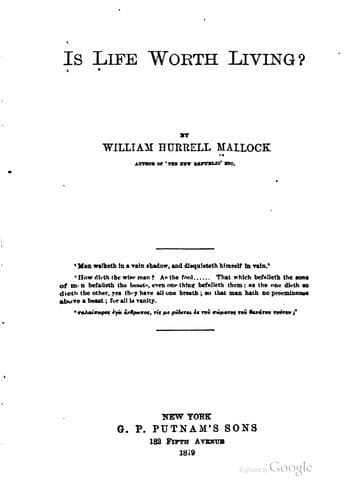
Is Life Worth Living?Mallock, W. H. (William Hurrell)
Philosophy
Is Life Worth Living?
Mallock, W. H. (William Hurrell)
Ethics; Life
Stephen] knows as much as [his]
dog_.'
The critic, in the foregoing passages, draws his conclusion from the
condition of but one Protestant doctrine. But he might draw the same
conclusion from all; for the condition of all of them is the same. The
divinity of Christ, the nature of his atonement, the constitution of the
Trinity, the efficacy of the sacraments, the inspiration of the
Bible--there is not one of these points on which the doctrines, once so
fiercely fought for, are not now, among the Protestants, getting as
vague and varying, as weak and as compliant to the caprice of each
individual thinker, as the doctrine of eternal punishment. And Mr.
Stephen and his school exaggerate nothing in the way in which they
represent the spectacle. Protestantism, in fact, is at last becoming
explicitly what it always was implicitly, not a supernatural religion
which fulfils the natural, but a natural religion which denies the
supernatural.
And what, as a natural religion, is its working power in the world? Much
of its earlier influence doubtless still survives; but that is a
survival only of what is passing, and we must not judge it by that. We
must judge it by what it is growing into, not by what it is growing out
of. And judged in this way, its practical power--its moral, its
teaching, its guiding power--is fast growing as weak and as uncertain as
its theology. As long as its traditional moral system is in accordance
with what men, on other grounds, approve of, it may serve to express the
general tendency impressively, and to invest it with the sanction of
many reverend associations. But let the general tendency once begin to
conflict with it, and its inherent weakness in an instant becomes
apparent. We may see this by considering the moral character of Christ,
and the sort of weight that is claimed for His example. This example, so
the Christian world teaches, is faultless and infallible; and as long as
we believe this, the example has supreme authority. But apply to this
the true Protestant method, and the authority soon shows signs of
wavering. Let us once deny that Christ was more than a faultless man,
and we lose by that denial our authority for asserting that he was as
much as a faultless man. Even should it so happen that we do approve
entirely of his conduct, it is we who are approving of him, not he who
is approving of us. The old position is reversed: we become the patrons
of our most worthy Judge eternal; and the moral infallibility is
transferred from him to ourselves. In other words, the practical
Protestant formula can be nothing more than this. The Protestant teacher
says to us, '_Such a way of life is the best, take my word for it: and
if you want an example, go to that excellent Son of David, who, take my
word for it, was the very best of men._' But even in this case the
question arises, how shall the Protestants interpret the character that
they praise? And to this they can never give any satisfactory answer.
Public-domain text, read in full here on John Shaqi.
Reviews
Reviews
No reviews yet
Be the first to share your thoughts on this work.
Elsewhere in the archive
Join the Discussion
Join the discussion
Sign in to leave a comment or review.
Sign InorCreate an account