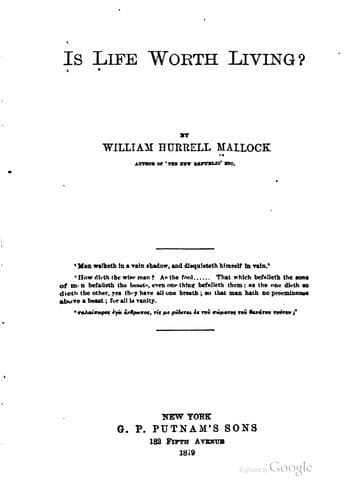
Is Life Worth Living?Mallock, W. H. (William Hurrell)
Philosophy
Is Life Worth Living?
Mallock, W. H. (William Hurrell)
Ethics; Life
Let us remember first, then, to take a general view of the matter, that
history as cited in witness against the Christian Revelation, divides
itself into two main branches. The one is a critical examination of
Christianity, taken by itself--the authorship, and the authenticity of
its sacred books, and the origin and growth of its doctrines. The other
is a critical examination of Christianity as compared with other
religions. And the result of both these lines of study is, to those
brought up in the old faith, to the last degree startling, and in
appearance at least altogether disastrous. Let us sum up briefly the
general results of them; and first of these the historical.
We shall begin naturally with the Bible, as giving us the earliest
historical point at which Christianity is assailable. What then has
modern criticism accomplished on the Bible? The Biblical account of the
creation it has shown to be, in its literal sense, an impossible fable.
To passages thought mystical and prophetic it has assigned the
homeliest, and often retrospective meanings. Everywhere at its touch
what seemed supernatural has been humanized, and the divinity that
hedged the records has rapidly abandoned them. And now looked at in the
common daylight their whole aspect changes for us; and stories that we
once accepted with a solemn reverence seem childish, ridiculous,
grotesque, and not unfrequently barbarous. Or if we are hardly prepared
to admit so much as this, this much at least has been established
firmly--that the Bible, if it does not give the lie itself to the
astonishing claims that have been made for it, contains nothing in
itself, at any rate, that can of itself be sufficient to support them.
This applies to the New Testament just as much as to the Old; and the
consequences here are even more momentous. Weighed as mere human
testimony, the value of the Gospels becomes doubtful or insignificant.
For the miracles of Christ, and for his superhuman nature, they contain
little evidence, that even tends to be satisfactory; and even his daily
words and actions it seems probable may have been inaccurately reported,
in some cases perhaps invented, and in others supplied by a deceiving
memory. When we pass from the Gospels to the Epistles, a kindred sight
presents itself. We discern in them the writings of men not inspired
from above; but, with many disagreements amongst themselves, struggling
upwards from below, influenced by a variety of existing views, and
doubtful which of them to assimilate. We discern in them, as we do in
other writers, the products of their age and of their circumstances. The
materials out of which they formed their doctrines we can find in the
lay world around them. And as we follow the Church's history farther,
and examine the appearance and the growth of her great subsequent
dogmas, we can trace all of them to a natural and a non-Christian
origin. We can see, for instance, how in part, at least, men conceived
Public-domain text, read in full here on John Shaqi.
Reviews
Reviews
No reviews yet
Be the first to share your thoughts on this work.
Elsewhere in the archive
Join the Discussion
Join the discussion
Sign in to leave a comment or review.
Sign InorCreate an account