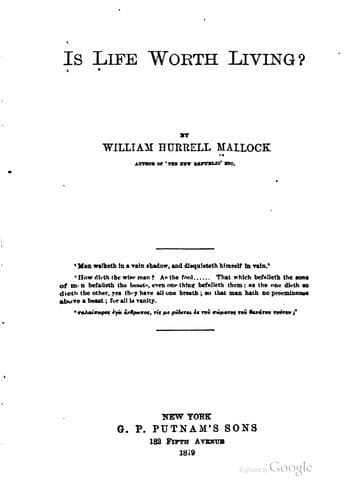
Is Life Worth Living?Mallock, W. H. (William Hurrell)
Philosophy
Is Life Worth Living?
Mallock, W. H. (William Hurrell)
Ethics; Life
But granting all this, what does this do for her? Does it do more than
present her to us as the toughest and most fortunate religion, out of
many co-ordinate and competing ones? Does it tend in any way to set her
on a different platform from the others? And the answer to this is,
that, so far as exact proof goes, we have nothing to expect or deal with
in the matter, either one way or the other. The evidences at our
disposal will impart a general tendency to our opinions, but no more
than that. The general tendency here, however, is the very reverse of
what it is vulgarly supposed to be. So far from the similarities to her
in other religions telling against the special claims of the Catholic
Church, they must really, with the candid theist, tell very strongly in
her favour. For the theist, all theisms have a profound element of truth
in them; and all alleged revelations will, in his eyes, be natural
theisms, struggling to embody themselves in some authorised and
authoritative form. The Catholic Church, as we have seen, is a human
organism, capable of receiving the Divine Spirit; and this is what all
other religious bodies, in so far as they have claimed authority for
their teaching, have consciously or unconsciously attempted to be
likewise; only the Catholic Church represents success, where the others
represent failure: and thus these, from the Catholic stand-point, are
abortive and incomplete Catholicisms. The Bethesda of human faith is
world-wide and as old as time; only in one particular spot an angel has
come down and troubled it; and the waters have been circling there,
thenceforth, in a healing vortex. Such is the sort of claim that the
Catholic Church makes for herself; and, if this be so, what she is, does
not belie what she claims to be. Indeed, the more we compare her with
the other religions, her rivals, the more, even where she most resembles
them, shall we see in her a something that marks her off from them. The
others are like vague and vain attempts at a forgotten tune; she is like
the tune itself, which is recognised the instant it is heard, and which
has been so near to us all the time, though so immeasurably far away
from us. The Catholic Church is the only dogmatic religion that has seen
what dogmatism really implies, and what will, in the long run, be
demanded of it, and she contains in herself all appliances for meeting
these demands. She alone has seen that if there is to be an infallible
voice in the world, this voice must be a living one, as capable of
speaking now as it ever was in the past; and that as the world's
capacities for knowledge grow, the teacher must be always able to unfold
to it a fuller teaching. The Catholic Church is the only historical
religion that can conceivably thus adapt itself to the wants of the
present day, without virtually ceasing to be itself. It is the only
religion that can keep its identity without losing its life, and keep
Public-domain text, read in full here on John Shaqi.
Reviews
Reviews
No reviews yet
Be the first to share your thoughts on this work.
Elsewhere in the archive
Join the Discussion
Join the discussion
Sign in to leave a comment or review.
Sign InorCreate an account