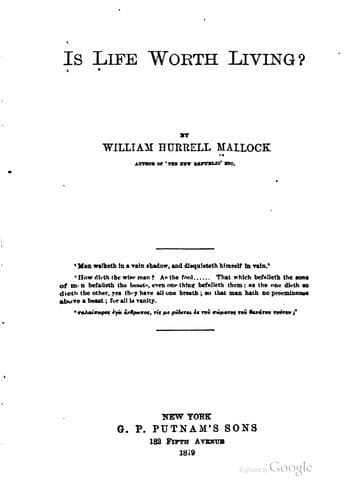
Is Life Worth Living?Mallock, W. H. (William Hurrell)
Philosophy
Is Life Worth Living?
Mallock, W. H. (William Hurrell)
Ethics; Life
As a pioneer, and not as a preacher, I have tried to indicate the real
position in which modern knowledge has placed us, and the way in which
it puts the problem of life before us. I have tried to show that,
whatever ultimately its tendency may prove to be, it cannot be the
tendency that, by the school that has given it to us, it is supposed to
have been; and that it either does a great deal more than that school
thinks it does, or a great deal less. History would teach us this, even
if nothing else did. The school in question has proceeded from denial to
denial, thinking at each successive moment that it had reached its final
halting-place, and had struck at last on a solid and firm foundation.
First, it denied the Church to assert the Bible; then it denied the
Bible to assert God; then it denied God to assert the moral dignity of
man: and there, if it could remain, it would. But what it would do is of
no avail. It is not its own master; it is compelled to move onwards; and
now, under the force of its own relentless logic, this last
resting-place is beginning to fail also. It professed to compensate for
its denials of God's existence by a freer and more convincing
re-assertion of man's dignity. But the principles which obliged it to
deny the first belief are found to be even more fatal to the
substitute. '_Unless I have seen with my eyes I will not believe_,'
expresses a certain mental tendency that has always had existence. But
till Science and its positive methods began to dawn on the world, this
tendency was vague and wavering. Positive Science supplied it with solid
nutriment. Its body grew denser; its shape more and more definite; and
now the completed portent is spreading its denials through the whole
universe. So far as spirit goes and spiritual aspirations, it has left
existence empty, swept and garnished. If spirit is to enter in again and
dwell there, we must seek by other methods for it. Modern thought has
not created a new doubt; it has simply made perfect an old one; and has
advanced it from the distant regions of theory into the very middle of
our hearts and lives. It has made the question of belief or of unbelief
the supreme practical question for us. It has forced us to stake
everything on the cast of a single die. What are we? Have we been
hitherto deceived in ourselves, or have we not? And is every hope that
has hitherto nerved our lives, melting at last away from us, utterly and
for ever? Or are we indeed what we have been taught to think we are?
Have we indeed some aims that we may still call high and holy--still
some aims that are more than transitory? And have we still some right to
that reverence that we have learnt to cherish for ourselves?
Public-domain text, read in full here on John Shaqi.
Reviews
Reviews
No reviews yet
Be the first to share your thoughts on this work.
Elsewhere in the archive
Join the Discussion
Join the discussion
Sign in to leave a comment or review.
Sign InorCreate an account