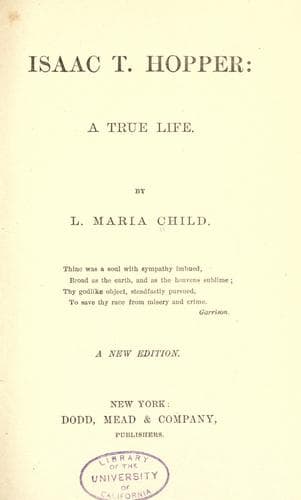
Fugitive slaves -- United States; Hopper, Isaac T. (Isaac Tatem), 1771-1852
It was then suggested that it might be well to retain a lawyer with a
portion of the seventeen hundred dollars he said he had to spare.
"I have been to Mr. Broome," rejoined the doctor. "He tells me that you
understand the law in such cases as well as he does; and he advises me
to let the matter alone."
"I will give thee permission to search my house," said Friend Hopper;
"and I have more authority in that matter than any magistrate, judge, or
lawyer, in the city."
"That is very gentlemanly," replied the doctor; "but I infer from it
that the woman is not in your house."
He was again assured that she was not; and they fell into some general
discourse on the subject of slavery. "Suppose you came to Maryland and
lost your horse," said the Doctor. "If you called upon me, and I told
you that I knew where he was, but would not inform you, would you
consider yourself treated kindly?" "In such a case, I should not
consider myself well treated," replied Friend Hopper. "But in this part
of the country, we make a distinction between horses and men. We believe
that human beings have souls."
"That makes no difference," rejoined the Doctor. "You confess that you
could find my slave if you were so disposed; and I consider it your duty
to tell me where she is." "I will do it when I am of the same opinion,"
replied Friend Hopper; "but till then thou must excuse me."
The fugitive was protected by a colored man named Hill, who soon
obtained a situation for her as servant in a respectable country family,
where she was kindly treated. In the course of a year or two, she
returned to Philadelphia, married a steady industrious man, and lived
very comfortably.
Public-domain text, read in full here on John Shaqi.
Reviews
Reviews
No reviews yet
Be the first to share your thoughts on this work.
Elsewhere in the archive
Join the Discussion
Join the discussion
Sign in to leave a comment or review.
Sign InorCreate an account