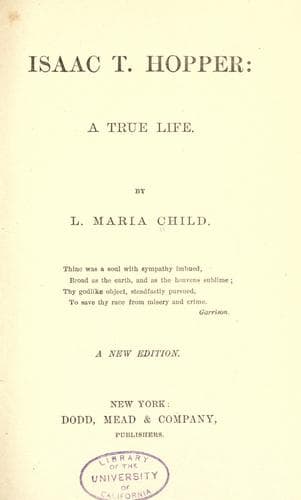
Fugitive slaves -- United States; Hopper, Isaac T. (Isaac Tatem), 1771-1852
As for the colored people of Philadelphia, they believed in his
infallibility, as devout Catholics believe in the Pope. They trusted
him, and he trusted them; and it is remarkable in how few instances he
found his confidence misplaced. The following anecdote will illustrate
the nature of the relation existing between him and that much abused
race. Prince Hopkins, a wood-sawyer of Philadelphia, was claimed as a
fugitive slave by John Kinsmore of Baltimore. When Friend Hopper went
to the magistrate's office to inquire into the affair, he found the poor
fellow in tears. He asked for a private interview, and the alderman gave
his consent. When they were alone, Prince confessed that he was the
slave in question. In the course of his narrative, it appeared that he
had been sent into Pennsylvania by his mistress, and had resided there
with a relative of hers two years. Friend Hopper told him to dry up his
tears, for it was in his power to protect him. When he returned to the
office, he informed the magistrate that Prince Hopkins was a free man;
having resided in Pennsylvania, with the consent of his mistress, a much
longer time than the law required. Mr. Kinsmore was irritated, and
demanded that the colored man should be imprisoned till he could obtain
legal advice.
"Let him go and finish the wood he was sawing," said Friend Hopper. "I
will be responsible for his appearance whenever he is wanted. If the
magistrate will give me a commitment, Prince will call at my house after
he has finished sawing his wood, and I will send him to jail with it. He
can remain there, until the facts I have stated are clearly proved."
The slave-holder and his lawyer seemed to regard this proposition as an
insult. They railed at Friend Hopper for his "impertinent interference,"
and for the absurd idea of trusting "that nigger" under such
circumstances.
He replied, "I would rather trust 'that nigger,' as you call him, than
either of you." So saying, he marched off with the magistrate's mittimus
in his pocket.
When Prince Hopkins had finished his job of sawing, he called for the
commitment, and carried it to the jailor, who locked him up.
Satisfactory evidence of his freedom was soon obtained, and he was
discharged.
The colored people appeared to better advantage with their undoubted
friend, than they possibly could have done where a barrier of prejudice
existed. They were not afraid to tell him their experiences in their own
way, with natural pathos, here and there dashed with fun. A
fine-looking, athletic fugitive, telling him his story one day, said,
"When I first run away, I met some people who were dreadful afraid I
couldn't take care of myself. But thinks I to myself I took care of
master and myself too for a long spell; and I guess I can make out."
With a roguish expression laughing all over his face, he added, "I don't
look as if I was suffering for a master; do I, Mr. Hopper?"
Public-domain text, read in full here on John Shaqi.
Reviews
Reviews
No reviews yet
Be the first to share your thoughts on this work.
Elsewhere in the archive
Join the Discussion
Join the discussion
Sign in to leave a comment or review.
Sign InorCreate an account