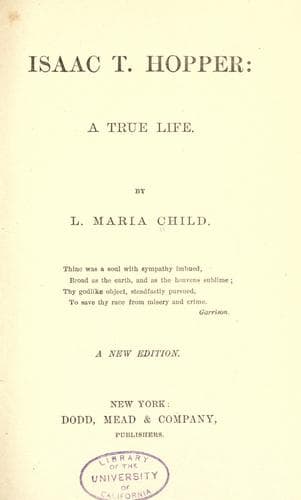
Fugitive slaves -- United States; Hopper, Isaac T. (Isaac Tatem), 1771-1852
The poor man was invited to walk into the house. The interest was
calculated on the fine, and every cent repaid to him. "I meant it for
thy good," said the benevolent Quaker; "and I am sorry that I only
provoked thee." Kane's countenance changed at once, and tears began to
flow. He took the money with many thanks, and was never again heard to
swear.
Friend Hopper's benevolence was by no means confined to colored people.
Wherever there was good to be done, his heart and hand were ready. From
various anecdotes in proof of this, I select the following.
JOHN McGRIER.
John was an Irish orphan, whose parents died of yellow fever, when he
was very young. He obtained a scanty living by doing errands for
cartmen. In the year 1800, when he was about fourteen years old, there
was a long period during which he could obtain scarcely any employment.
Being without friends, and in a state of extreme destitution, he was
tempted to enter a shop and steal two dollars from the drawer. He was
pursued and taken. Isaac T. Hopper, who was one of the inspectors of the
prison at that time, saw a crowd gathered, and went to inquire the
cause. The poor boy's history was soon told. Friend Hopper liked the
expression of his countenance, and pitied his forlorn condition. When he
was brought up for trial, he accompanied him, and pleaded with the
judge in his favor. He urged that the poor child's education had been
entirely neglected, and consequently he was more to be pitied than
blamed. If sent to prison, he would in all probability become hardened,
if not utterly ruined. He said if the judge would allow him to take
charge of the lad, he would promise to place him in good hands, where he
would be out of the way of temptation. The judge granted his request,
and John was placed in prison merely for a few days, till Friend Hopper
could provide for him. He proposed to his father to have the boy bound
to him. The old gentleman hesitated at first, on account of his
neglected education and wild way of living; but pity for the orphan
overcame his scruples, and he agreed to take him. John lived with him
till he was twenty-one years of age, and was remarkably faithful and
industrious. But about two years after, a neighbor came one night to
arrest him for stealing a horse. Old Mr. Hopper assured him it was not
possible John had done such a thing; that during all the time he had
lived in his family he had proved himself entirely honest and
trustworthy. The neighbor replied that his horse had been taken to
Philadelphia and sold; and the ferryman from Woodbury was ready to swear
that the animal was brought over by Hopper's John, as he was generally
called. John was in bed, but was called up to answer the accusation. He
did not attempt to deny it, but gave up the money at once, and kept
repeating that he did know what made him do it. He was dreadfully
ashamed and distressed. He begged that Friend Isaac would not come to
see him in prison, for he could not look him the face.
Public-domain text, read in full here on John Shaqi.
Reviews
Reviews
No reviews yet
Be the first to share your thoughts on this work.
Elsewhere in the archive
Join the Discussion
Join the discussion
Sign in to leave a comment or review.
Sign InorCreate an account