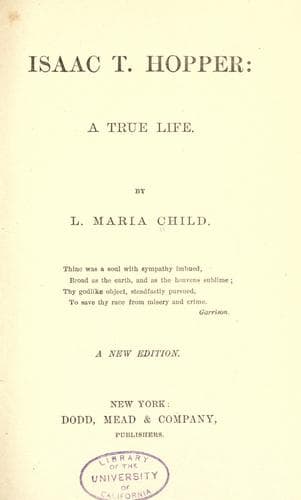
Fugitive slaves -- United States; Hopper, Isaac T. (Isaac Tatem), 1771-1852
Such a character as Isaac T. Hopper was of course well known throughout
the city where he lived. Every school-boy had heard something of his
doings, and as he walked the street, everybody recognized him, from the
chief justice to the chimney-sweep. His personal appearance was
calculated to attract attention, independent of other circumstances.
Joseph Bonaparte, who then resided at Bordentown, was attracted toward
him the first moment he saw him, on account of a strong resemblance to
his brother Napoleon. They often met in the steamboat going down the
Delaware, and on such occasions, the ex-king frequently pointed him out
as the most remarkable likeness of the emperor, that he had ever met in
Europe or America. He expressed the opinion that with Napoleon's uniform
on, he might be mistaken for him, even by his own household; and if he
were to appear thus in Paris, nothing could be easier than for him to
excite a revolution.
But the imperial throne, even if it had been directly offered to him,
would have proved no temptation to a soul like his. In some respects,
his character, as well as his person, strongly resembled Napoleon. But
his powerful will was remarkably under the control of conscience, and
his energy was tempered by an unusual share of benevolence. If the
other elements of his character had not been balanced by these two
qualities, he also might have been a skilful diplomatist, and a
successful leader of armies. Fortunately for himself and others, he had
a nobler ambition than that of making widows and orphans by wholesale
slaughter. The preceding anecdotes show how warmly he sympathized with
the poor, the oppressed, and the erring, without limitation of country,
creed, or complexion; and how diligently he labored in their behalf. But
from the great amount of public service that he rendered, it must not be
inferred that he neglected private duties. Perhaps no man was ever more
devotedly attached to wife and children than he was. His Sarah, as he
was wont to call her, was endowed with qualities well calculated to
retain a strong hold on the affections of a sensible and conscientious
man. Her kindly disposition, and the regular, simple habits of her life,
were favorable to the preservation of that beauty, which had won his
boyish admiration. Her wavy brown hair was softly shaded by the delicate
transparent muslin of her Quaker cap; her face had a tender and benign
expression; and her complexion was so clear, that an old gentleman, who
belonged to the Society of Friends, and who was of course not much
addicted to poetic comparisons, used to say he could never look at her
without thinking of the clear pink and white of a beautiful
conch-shell. She was scrupulously neat, and had something of that
chastened coquetry in dress, which is apt to characterize the handsome
women of her orderly sect. Her drab-colored gown, not high in the neck,
was bordered by a plain narrow tucker of fine muslin, visible under her
snow-white neckerchief.
Public-domain text, read in full here on John Shaqi.
Reviews
Reviews
No reviews yet
Be the first to share your thoughts on this work.
Elsewhere in the archive
Join the Discussion
Join the discussion
Sign in to leave a comment or review.
Sign InorCreate an account