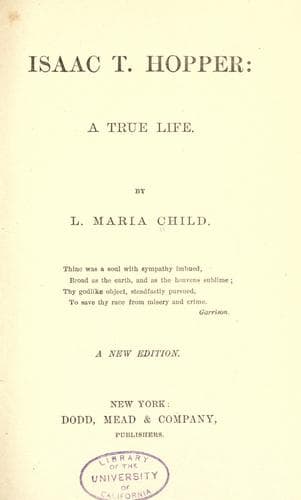
Fugitive slaves -- United States; Hopper, Isaac T. (Isaac Tatem), 1771-1852
Friend Hopper used to tell another story, which forms a beautiful
contrast to the foregoing painful narrative. I repeat it, because it
illustrates the tenderness of spirit, which has so peculiarly
characterized the Society of Friends, and because I hope it may fall
like dew on hearts parched by vindictive feelings. Charles Carey lived
near Philadelphia, in a comfortable house with a few acres of pasture
adjoining. A young horse, apparently healthy, though lean, was one day
offered him in the market for fifty dollars. The cheapness tempted him
to purchase; for he thought the clover of his pastures would soon put
the animal in good condition, and enable him to sell him at an advanced
price. He was too poor to command the required sum himself, but he
borrowed it of a friend. The horse, being well fed and lightly worked,
soon became a noble looking animal, and was taken to the city for sale.
But scarcely had he entered the market, when a stranger stepped up and
claimed him as his property, recently stolen. Charles Carey's son, who
had charge of the animal, was taken before a magistrate. Isaac T. Hopper
was sent for, and easily proved that the character of the young man and
his father was above all suspicion. But the stranger produced
satisfactory evidence that he was the rightful owner of the horse, which
was accordingly delivered up to him. When Charles Carey heard the
unwelcome news, he quietly remarked, "It is hard for me to lose the
money; but I am glad the man has recovered his property."
About a year afterward, having occasion to go to a tavern in
Philadelphia, he saw a man in the bar-room, whom he at once recognized
as the person who had sold him the horse. He walked up to him, and
inquired whether he remembered the transaction. Being answered in the
affirmative, he said, "I am the man who bought that horse. Didst thou
know he was stolen?" With a stupified manner and a faltering voice, the
stranger answered, "Yes."
"Come along with me, then," said Charles; "and I will put thee where
thou wilt not steal another horse very soon."
The thief resigned himself to his fate with a sort of hopeless
indifference. But before they reached the magistrate's office, the voice
within began to plead gently with the Quaker, and turned him from the
sternness of his purpose. "I am a poor man," said he, "and thou hast
greatly injured me. I cannot afford to lose fifty dollars; but to
prosecute thee will not compensate me for the loss. Go thy way, and
conduct thyself honestly in future."
The man seemed amazed. He stood for a moment, hesitating and confused;
then walked slowly away. But after taking a few steps, he turned back
and said, "Where can I find you, if I should ever be able to make
restitution for the wrong I have done?"
Charles replied, "I trust thou dost not intend to jest with me, after
all the trouble thou hast caused me?"
"No, indeed I do not," answered the stranger. "I hope to repay you, some
time or other."
Public-domain text, read in full here on John Shaqi.
Reviews
Reviews
No reviews yet
Be the first to share your thoughts on this work.
Elsewhere in the archive
Join the Discussion
Join the discussion
Sign in to leave a comment or review.
Sign InorCreate an account