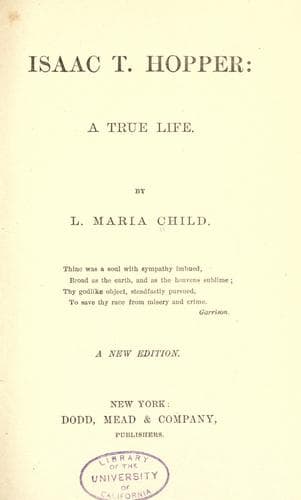
Fugitive slaves -- United States; Hopper, Isaac T. (Isaac Tatem), 1771-1852
The government added its exactions to other pecuniary annoyances; but it
had no power to warp the inflexibility of his principles. He had always
refused to pay the militia tax, because, in common with all
conscientious Quakers, he considered it wrong to do anything for the
support of war. It seems no more than just that a sect, who pay a double
school-tax, and a double pauper-tax, and who almost never occasion the
state any expense by their crimes, should be excused for believing
themselves bound to obey the injunction of Jesus, to return good for
evil; but politicians have decided that practical Christianity is not
always consistent with the duty of citizens. Accordingly, when Friend
Hopper refused to pay for guns and swords, to shoot and stab his fellow
men, they seized his goods to pay the tax. The articles chosen were
often of much greater value than their demand, and were sacrificed by a
hurried and careless sale. His wife had received a handsome outfit from
her father, at the time of her marriage; but she was destined to see one
article of furniture after another seized to pay the military fines,
which were alike abhorrent to her heart and her conscience. Among these
articles, was a looking glass, of an unusually large and clear plate,
which was valuable as property, and dear to her as a bridal gift from
her parents. She could not see it carried off by the officer, to meet
the expenses of military reviews, without a sigh--perhaps a tear. But
she was not a woman ever to imply a wish to have her husband compromise
his principles.
Public-domain text, read in full here on John Shaqi.
Reviews
Reviews
No reviews yet
Be the first to share your thoughts on this work.
Elsewhere in the archive
Join the Discussion
Join the discussion
Sign in to leave a comment or review.
Sign InorCreate an account