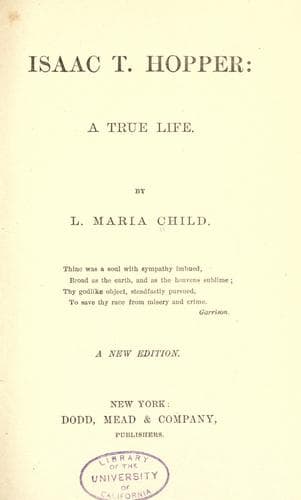
Fugitive slaves -- United States; Hopper, Isaac T. (Isaac Tatem), 1771-1852
Soon after this melancholy event, Friend Hopper went to Maryland, to
visit two sisters who resided there. He was accompanied in this journey
by his wife's brother, David Tatum. At an inn where they stopped for
refreshment, the following characteristic incident occurred: A colored
girl brought in a pitcher of water. "Art thou a slave?" said Friend
Hopper. When she answered in the affirmative, he started up and
exclaimed, "It is against my principles to be waited upon by a slave."
His more timid brother-in-law inquired, in a low tone of voice, whether
he were aware that the mistress was within hearing. "To be sure I am,"
answered Isaac aloud. "What would be the use of saying it, if she were
_not_ within hearing?" He then emptied the pitcher of water, and went
out to the well to re-fill it for himself. Seeing the landlady stare at
these proceedings, he explained to her that he thought it wrong to avail
himself of unpaid labor. In reply, she complained of the ingratitude of
slaves, and the hard condition of their masters. "It is very
inconvenient to live so near a free state," said she. "I had sixteen
slaves; but ten of them have run away, and I expect the rest will soon
go."
"I hope they will," said Isaac. "I am sure I would run away, if I were a
slave."
At first, she was disposed to be offended; but he reasoned the matter
with her, in a quiet and friendly manner, and they parted on very civil
terms. David Tatum often used to tell this anecdote, after they returned
home; and he generally added, "I never again will travel in a Southern
state with brother Isaac; for I am sure it would be at the risk of my
life."
Public-domain text, read in full here on John Shaqi.
Reviews
Reviews
No reviews yet
Be the first to share your thoughts on this work.
Elsewhere in the archive
Join the Discussion
Join the discussion
Sign in to leave a comment or review.
Sign InorCreate an account