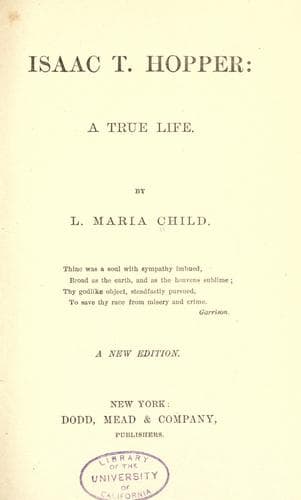
Fugitive slaves -- United States; Hopper, Isaac T. (Isaac Tatem), 1771-1852
In the autumn of the following year, some disputed claims, which his
wife had on the estate of her maternal grandfather in Ireland, made it
necessary for him to visit that country. Experience had painfully
convinced him that theological controversy sometimes leads to personal
animosity; and that few people were so open and direct in their mode of
expressing hostility, as he himself was. Therefore, before going abroad,
he took the precaution to ask letters from citizens of various classes
and sects in Philadelphia; and he found no difficulty in obtaining them
from the most respectable and distinguished. Matthew Carey, the well
known philanthropist wrote as follows: "As you are about to visit my
native country, and have applied to me for a testimonial concerning your
character, I cheerfully comply with your request. I have been well
acquainted with you for about thirty-five years, and I can testify that,
during the whole of that time, you have been a perfect pest to our
Southern neighbors. A Southern gentleman could scarcely visit this city,
without having his slave taken from him by your instrumentality; so
that they dread you, as they do the devil." After enjoying a mutual
laugh over this epistle, another was written for the public, certifying
that he had known Isaac T. Hopper for many years as "a useful and
respectable citizen of the fairest character."
When Friend Hopper arrived in Ireland, he found many of the Quakers
prejudiced against him, and many untrue stories in circulation, as he
had expected. Sometimes, when he visited public places, he would
overhear people saying to each other, in a low voice, "That's Isaac T.
Hopper, who has given Friends so much trouble in America." A private
letter from an "Orthodox" Quaker in Philadelphia was copied and
circulated in all directions, greatly to his disadvantage. It
represented him as a man of sanctified appearance, but wholly unworthy
of credit; that business of a pecuniary nature was a mere pretence to
cover artful designs; his real object being to spread heretical
doctrines in Ireland, and thus sow dissension among Friends. In his
journal of this visit to a foreign land, Friend Hopper says: "It is
astonishing what strange ideas some of them have concerning me. They
have been informed that I can find stolen goods, and am often applied to
on such occasions. I think it would be no hard matter to make them
believe me a wizard." This was probably a serious version of his
pleasantry with the Dutchman about finding his goods by calculating the
age of the moon.
Public-domain text, read in full here on John Shaqi.
Reviews
Reviews
No reviews yet
Be the first to share your thoughts on this work.
Elsewhere in the archive
Join the Discussion
Join the discussion
Sign in to leave a comment or review.
Sign InorCreate an account