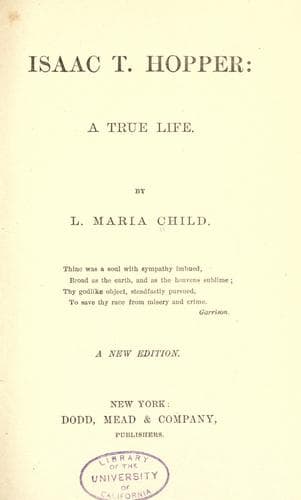
Fugitive slaves -- United States; Hopper, Isaac T. (Isaac Tatem), 1771-1852
In fact, wherever he had a chance to make himself known, prejudices
melted away under the influence of his frank and kindly manners. Some
people of other sects, as well of his own, took an interest in him for
the very reasons that caused distrust and dislike in others; viz:
because they had heard of him as the champion of perfect liberty of
conscience, who considered it unnecessary to bind men by any creed
whatsoever. Among these, he mentions in his journal, Professor Stokes of
Dublin, who relinquished a salary of two thousand eight hundred pounds a
year, because he could not conscientiously subscribe to the doctrine of
the Trinity. It was proposed to dismiss him from the college altogether;
but he demanded a hearing before the trustees and students. This
privilege could not be denied, without infringing the laws of the
institution; and deeming that such a discussion might prove injurious,
they concluded to retain him, on a salary of eight hundred pounds.
Friend Hopper describes him thus: "He is an intelligent and
liberal-minded man, and has a faculty of exposing the errors and
absurdities of the Athanasian Creed to much purpose. He was of a good
spirit, and I was much gratified with his company. He insisted upon
accompanying me home in the evening, and though I remonstrated against
it, on account of his advanced age, he attended me to the door of my
lodgings."
During this visit to Ireland, Friend Hopper was treated with great
hospitality and respect by many who were wealthy, and many who were not
wealthy; by members of the Society of Friends, and of various other
religious sects. He formed a high estimate of the Irish character, and
to the day of his death, always spoke with warm affection of the friends
he found there. In his journal, he often alludes with pleasure to the
children he met with, in families where he visited; for he was always
extremely partial to the young. Speaking of a visit to a gentleman in
the environs of Dublin, by the name of Wilson, he says: "I rose early
in the morning, and the eldest daughter, about ten or eleven years old,
very politely invited me to walk with her. We rambled about in the
pastures, and through beautiful groves of oak, beech and holly. The
little creature tried her very best to amuse me. She told me about the
birds and the hares, and other inhabitants of the woods. She inquired
whether I did not want very much to see my wife and children; and
exclaimed, 'How I should like to see you meet them! It would give you so
much pleasure!'" He speaks of a little girl in another family, who seemed
very much attracted toward him, and finally whispered to her father, "I
want to go and speak to that Friend." She was introduced accordingly,
and they had much pleasant chat together.
Public-domain text, read in full here on John Shaqi.
Reviews
Reviews
No reviews yet
Be the first to share your thoughts on this work.
Elsewhere in the archive
Join the Discussion
Join the discussion
Sign in to leave a comment or review.
Sign InorCreate an account