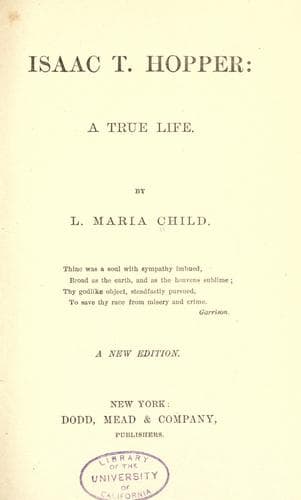
Fugitive slaves -- United States; Hopper, Isaac T. (Isaac Tatem), 1771-1852
Friend Hopper's bookstore in New-York was a place of great resort for
members of his own sect. His animated style of conversation, his
thousand and one anecdotes of runaway slaves, his descriptions of keen
encounters with the "Orthodox," in the process of separation, attracted
many listeners. His intelligence and well-known conscientiousness
commanded respect, and he was held in high estimation by his own branch
of the Society, though the opposite party naturally entertained a less
favorable opinion of the "Hicksite" champion. Such a character as he was
must necessarily always be a man of mark, with warm friends and bitter
enemies.
His resemblance to Bonaparte attracted attention in New-York, as it had
done in Philadelphia. Not long after he removed to that city, there was
a dramatic representation at the Park Theatre, in which Placide
personated the French Emperor. While this play was attracting public
attention, the manager happened to meet Friend Hopper in the street. As
soon as he saw him, he exclaimed, "Here is Napoleon himself come back
again!" He remarked to some of his acquaintance that he would gladly
give that Quaker gentleman one hundred dollars a night, if he would
consent to appear on the stage in the costume of Bonaparte.
About this period northern hostility to slavery took a new form, more
bold and uncompromising than the old Abolition Societies. It demanded
the immediate and unconditional emancipation of every slave, in a voice
which has not yet been silenced, and never will be, while the
oppressive system continues to disgrace our country. Of course, Friend
Hopper could not otherwise than sympathize with any movement for the
abolition of slavery, based on pacific principles. Pictures and
pamphlets, published by the Anti-Slavery Society were offered for sale
in his book-store. During the popular excitement on this subject, in
1834, he was told that his store was about to be attacked by an
infuriated rabble, and he had better remove all such publications from
the window. "Dost thou think I am such a coward as to forsake my
principles, or conceal them, at the bidding of a mob?" said he.
Presently, another messenger came to announce that the mob were already
in progress, at the distance of a few streets. He was earnestly advised
at least to put up the shutters, that their attention might not be
attracted by the pictures. "I shall do no such thing," he replied. The
excited throng soon came pouring down the street, with loud and
discordant yells. Friend Hopper walked out and stood on the steps. The
mob stopped in front of his store. He looked calmly and firmly at them,
and they looked irresolutely at him, like a wild animal spell-bound by
the fixed gaze of a human eye. After a brief pause, they renewed their
yells, and some of their leaders called out, "Go on, to Rose-street!"
They obeyed these orders, and in the absent of Lewis Tappan, a
well-known abolitionist, they burst open his house, and destroyed his
furniture.
Public-domain text, read in full here on John Shaqi.
Reviews
Reviews
No reviews yet
Be the first to share your thoughts on this work.
Elsewhere in the archive
Join the Discussion
Join the discussion
Sign in to leave a comment or review.
Sign InorCreate an account