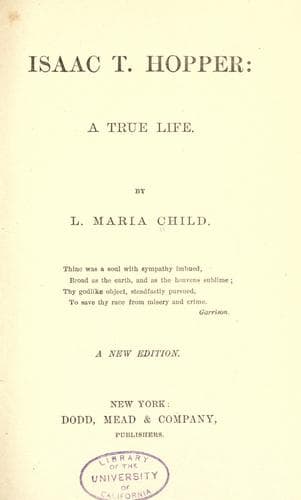
Fugitive slaves -- United States; Hopper, Isaac T. (Isaac Tatem), 1771-1852
Sierra Leone, they screamed with exultation. They shouted, "Here is what
we wanted! Here is proof of abolitionism!" Some of them rushed out and
told the mob, who crowded the bar-room and entries, that they had found
a trunk full of abolition tracts. Others seized Mr. Hopper violently,
telling him to say his last prayers, and go with them. The proprietor of
the City Hotel was very naturally alarmed for the safety of the
building. He was in a great passion, and conjured them to carry their
victim down forthwith; saying he could do nothing with the mob below,
who were getting very impatient waiting for him. Turning to Mr. Hopper,
he said, "Young man, you are in a very unfortunate situation. You ought
never to have left your home. But it is your own doing; and you deserve
your fate." When appealed to for protection, he exclaimed, "Good God!
you must not appeal to me. This is a damned delicate business. I shall
not be able to protect my own property. But I will go for the mayor."
One of the bar-keeper's confidential friends sent him a slip of paper,
on which was written, "His only mode of escape is by the window;" and
the bar-keeper, who had previously shown himself decidedly unfriendly,
urged him again and again to profit by this advice. He occupied the
third story, and the street below his window was thronged with an
infuriated mob, thirsting and clamoring for his blood. In view of these
facts, it seems not very uncharitable to suppose that the advice was
given to make sure of his death, apparently by his own act, and thus
save the city of Savannah from the disgrace of the deed. Of the two
terrible alternatives, he preferred going down-stairs into the midst of
the angry mob, who were getting more and more maddened by liquor, having
taken forcible possession of the bar. He considered his fate inevitable,
and had made up his mind to die. But at the foot of the stairs, he was
met by the mayor and several aldermen, whose timely arrival saved his
life. After asking some questions, and receiving the assurance that he
came to Savannah solely on commercial business, the magistrates
accompanied Mr. Hopper to his room, and briefly examined his books and
papers. The mayor then went down and addressed the mob, assuring them
that he should be kept in custody during the night; that strict
investigation should be made, and if there was the slightest evidence of
his being an abolitionist, he should not be suffered to go at large.
The mayor and a large body of civil officers accompanied the prisoner to
the guard-house, and a number of citizens volunteered their services, to
strengthen the escort; but all their efforts scarcely sufficed to keep
him from the grasp of the infuriated multitude. He was placed in a
noisome cell, to await his trial, and the customary guard was increased
for his protection. Portions of the mob continued howling round the
prison all night, and the mayor was sent for several times to prevent
their bursting in.
Public-domain text, read in full here on John Shaqi.
Reviews
Reviews
No reviews yet
Be the first to share your thoughts on this work.
Elsewhere in the archive
Join the Discussion
Join the discussion
Sign in to leave a comment or review.
Sign InorCreate an account