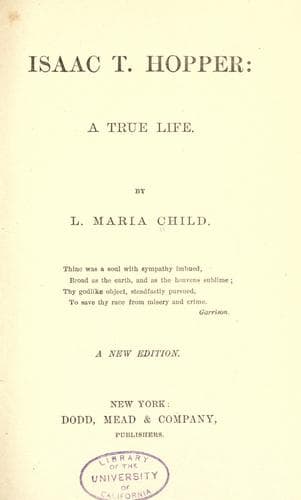
Fugitive slaves -- United States; Hopper, Isaac T. (Isaac Tatem), 1771-1852
When the traveller arrived at his home, he was so haggard and worn down
with danger and fatigue, that his family scarcely recognized him. His
father was much excited and deeply affected, when he heard what perils
he had gone through merely on account of his name. He soon after
addressed the following letter to the mayor of Savannah:
"New-York, 4th month, 18th, 1836.
"Friend,
"My object in addressing thee is to express my heartfelt gratitude
for thy exertions in saving the life of my son, which I have cause
to believe was in imminent peril, from the violence of unreasonable
men, while in your city a few weeks ago. I am informed that very
soon after his arrival in Savannah, the fact became known to a
marshal of this city, who was then there, and who, by his
misrepresentations, excited the rabble to a determination to
perpetrate the most inhuman outrage upon him, and in all
probability to take his life; and that preparations were made,
which, if carried into effect, would doubtless have produced that
result.
"Tar and feathers, as a mode of punishment, I am inclined to think
is rather of modern invention; and I am doubtful whether they will
be more efficient than whipping, cutting off ears, the rack, the
halter, and the stake. Superstition and intolerance have long ago
called in all these to their aid, in suppressing reformation in
religion; but they were unable to accomplish the end designed; and
if I am not greatly mistaken, they would prove entirely
insufficient to stop the progress of emancipation.
Public-domain text, read in full here on John Shaqi.
Reviews
Reviews
No reviews yet
Be the first to share your thoughts on this work.
Elsewhere in the archive
Join the Discussion
Join the discussion
Sign in to leave a comment or review.
Sign InorCreate an account