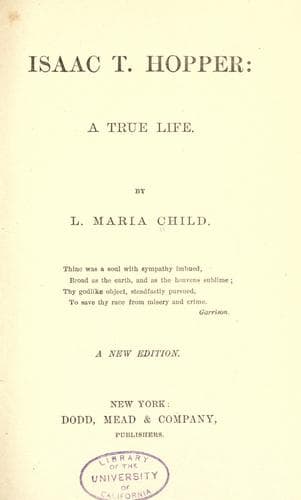
Fugitive slaves -- United States; Hopper, Isaac T. (Isaac Tatem), 1771-1852
"With fervent desires that the beneficent Creator and Father of the
Universe may open the eyes of all to see that 'the fast which he
hath chosen is to loose the bands of wickedness, to undo the heavy
burdens and to let the oppressed go free, and that ye break every
yoke.'
"I am thy sincere friend,
"ISAAC T. HOPPER."
Soon after the circumstances above related, the mayor of New-York
revoked the warrant of the marshal, who had been so conspicuous in the
outrage. This step was taken in consequence of his own admissions
concerning his conduct.
In 1837, a little incident occurred, which may be interesting to those
who are curious concerning phrenology. At a small social party in
New-York, a discussion arose on that subject; and, as usual, some were
disposed to believe and others to ridicule. At last the disputants
proposed to test the question by careful experiment. Friend Hopper was
one of the party, and they asked him to have his head examined by the
well-known O.S. Fowler. Having a good-natured willingness to gratify
their curiosity, he consented. It was agreed that he should not speak
during the operation, lest the tones of his voice might serve as an
index of his character. It was further stipulated that no person in the
room should give any indication by which the phrenologist might be
enabled to judge whether he was supposed to be speaking correctly or
not. The next day, Mr. Fowler was introduced blindfolded into a room,
where Isaac T. Hopper was seated with the party of the preceding
evening. Having passed his hands over the strongly developed head, he
made the following statement, which was taken down by a rapid writer, as
the words fell from his lips.
"The first and strongest manifestation of this character is efficiency.
Not one man in a thousand is capable of accomplishing so much. The
strong points are very strong; the weak points are weak; so that he is
an eccentric and peculiar character.
"The pole-star of his character is moral courage.
"He has very little reverence, and stands in no awe of the powers that
be. He pays no regard to forms or ceremonies, or established customs, in
church or state. He renders no homage to great names, such as D.D.;
L.L.D.; or Excellency. He treats his fellow men with kindness and
affection, but not with sufficient respect and courtesy.
"He is emphatically republican in feeling and character. He makes
himself free and familiar with every one. He often lets himself down too
much. This constitutes a radical defect in his character.
"He will assert and maintain human rights and liberty at every hazard.
In this cause, he will stake anything, or suffer anything. This
constitutes the leading feature of his character. Every other element is
blended into this.
"I should consider him a very cautious man in fact, though in appearance
he is very imprudent; especially in remarks on moral subjects.
Public-domain text, read in full here on John Shaqi.
Reviews
Reviews
No reviews yet
Be the first to share your thoughts on this work.
Elsewhere in the archive
Join the Discussion
Join the discussion
Sign in to leave a comment or review.
Sign InorCreate an account