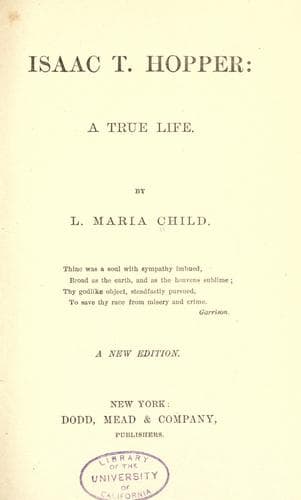
Fugitive slaves -- United States; Hopper, Isaac T. (Isaac Tatem), 1771-1852
The state of things among Quakers in the city of New-York may be
inferred from the fact that this minister was exceedingly popular, and
his style of preaching cordially approved by a majority of them. One of
the editors of the Anti-Slavery Standard, at that time, wrote a severe,
though by no means abusive article on the subject, headed "Rare
Specimen of a Quaker Preacher." This gave great offence, and Isaac T.
Hopper was very much blamed for it. He, and his son-in-law James S.
Gibbons, and his friend Charles Marriott, then belonged to the Executive
Committee of the Anti-Slavery Society; and it was assumed to be their
duty to have prevented the publication of the sarcastic article. Charles
Harriot was absent from the city when it was published, and Friend
Hopper did not see it till after it was in print. When they urged these
facts, and stated, moreover, that they had no right to dictate to the
editor what he should say, or what he should not say, they were told
that they ought to exculpate themselves by a public expression of their
disapprobation. But as they did not believe the editorial article
contained any mis-statement of facts, they could not conscientiously say
any thing that would satisfy the friends of the preacher. It would be
tedious to relate the difficulties that followed. There were visits from
overseers, and prolonged sessions of committees; a great deal of talking
_with_ the accused, and still more talking _about_ them. A strong
disposition was manifested to make capital against them out of the Darg
Case. Robert H. Morris, who was presiding Judge while that case was
pending, and afterward Mayor of New-York, had long known Friend Hopper,
and held him in much respect. When he was told that some sought to cast
imputations on his character, he was greatly surprised, and offered to
give favorable testimony in any form that might be desired. J.R.
Whiting, the District Attorney, expressed the same readiness; and
private misrepresentations were silenced by a published certificate from
them, testifying that throughout the affair Friend Hopper had merely
"exhibited a desire to procure the money for the master, and the
manumission of the slave."
Public-domain text, read in full here on John Shaqi.
Reviews
Reviews
No reviews yet
Be the first to share your thoughts on this work.
Elsewhere in the archive
Join the Discussion
Join the discussion
Sign in to leave a comment or review.
Sign InorCreate an account