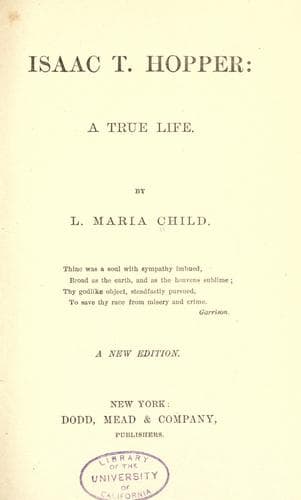
Fugitive slaves -- United States; Hopper, Isaac T. (Isaac Tatem), 1771-1852
There is James S. Gibbons, a young man, and therefore less known; but
wherever known, prized for his extreme kindness of heart, his steadfast
honesty of purpose, his undisguised sincerity, and his unflinching
adherence to his own convictions of duty. A Society has need to be very
rich in moral excellence, that can afford to throw away three such
members.
Protests and disclaimers against the disownment of these worthy men came
from several parts of the country, signed by Friends of high character;
and many private letters were addressed to them, expressive of sympathy
and approbation. Friend Hopper was always grateful for such marks of
respect and friendship; but his own conscience would have sustained him
without such aid. He had long felt a deep sadness whenever he was
reminded of the _spiritual_ separation between him and the religious
Society, whose preachers had exerted such salutary influence on his
youthful character; but the _external_ separation was of no consequence.
He attended meeting constantly, as he had ever done, and took his seat
on the bench under the preachers' gallery, facing the audience, where he
had always been accustomed to sit, when he was an honored member of the
Society. Charles Marriott, who was by temperament a much meeker man,
said to him one day, "The overseers have called upon me, to represent
the propriety of my taking another seat, under existing circumstances. I
expect they will call upon thee, to give the same advice."
"I expect they _won't_," was Isaac's laconic reply; and they never did.
His daughter, Abby H. Gibbons, soon after resigned membership in the
Monthly Meeting of New-York for herself and her children; and his sons
Josiah and John did the same. The grounds stated were that "the meeting
had manifestly departed from the original principles and testimonies of
the Society of Friends; that the plainest principles of civil and
religious freedom had been violated in the whole proceedings in relation
to their father; and that the overseers had prepared an official
document calculated to produce false impressions with regard to him;
accusing him of 'grossly reproachful conduct' in the well known Darg
Case; whereas there was abundant evidence before the public that his
proceedings in that case were influenced by the purest and most
disinterested motives."
Public-domain text, read in full here on John Shaqi.
Reviews
Reviews
No reviews yet
Be the first to share your thoughts on this work.
Elsewhere in the archive
Join the Discussion
Join the discussion
Sign in to leave a comment or review.
Sign InorCreate an account