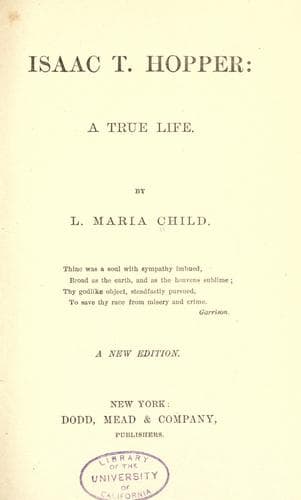
Fugitive slaves -- United States; Hopper, Isaac T. (Isaac Tatem), 1771-1852
In the course of the same month he accepted an invitation to attend the
Anti-Slavery Convention at Norristown, Pennsylvania. His appearance
there was quite an event. Many friends of the cause, who were strangers
to him, were curious to obtain a sight of him, and to hear him address
the meeting. Charles C. Burleigh, in an eloquent letter to the
Convention, says: "I am glad to hear that Isaac T. Hopper is to be
present. That tried old veteran, with his eye undimmed, his natural
strength unabated, his resolute look, and calm determined manner, before
which the blustering kidnapper, and the self-important oppressor have so
often quailed! With the scars of a hundred battles, and the wreaths of
an hundred victories in this glorious warfare. With his example of half
a century's active service in this holy cause, and his still faithful
adherence to it, through evil as well as good report, and in the face of
opposition as bitter as sectarian bigotry can stir up. Persecution
cannot bow the head, which seventy winters could not blanch, nor the
terrors of excommunication chill the heart, in which age could not
freeze the kindly flow of warm philanthropy."
I think it was not long after this excursion that his sister Sarah came
from Maryland to visit him. She was a pleasant, sensible matron, much
respected by all who knew her. I noted down at the time several
anecdotes of childhood and youth, which bubbled up in the course of
conversations between her and her brother. In her character the
hereditary trait of benevolence was manifested in a form somewhat
different from his. She had no children of her own, but she brought up,
on her husband's farm, nineteen poor boys and girls, and gave most of
them a trade. Nearly all of them turned out well.
In the winters of 1842 and '43, Friend Hopper complied with urgent
invitations to visit the Anti-Slavery Fair, in Boston; and seldom has a
warmer welcome been given to any man. As soon as he appeared in Amory
Hall, he was always surrounded by a circle of lively girls attracted by
his frank manners, his thousand little pleasantries, and his keen
enjoyment of young society. A friend of mine used to say that when she
saw them clustering round him, in furs and feathered bonnets, listening
to his words so attentively, she often thought it would make as fine a
picture as William Penn explaining his treaty to the Indians.
Public-domain text, read in full here on John Shaqi.
Reviews
Reviews
No reviews yet
Be the first to share your thoughts on this work.
Elsewhere in the archive
Join the Discussion
Join the discussion
Sign in to leave a comment or review.
Sign InorCreate an account