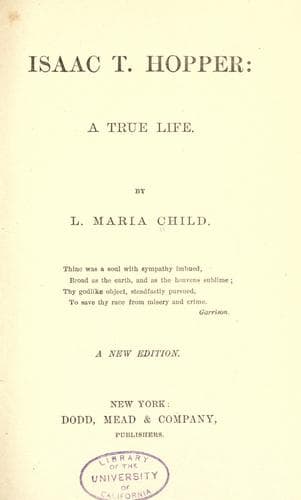
Fugitive slaves -- United States; Hopper, Isaac T. (Isaac Tatem), 1771-1852
He replied, "I have a mother; a poor hard-working woman, who sells fruit
and candies in the streets. If you will give me a start, I will try to
lead an honest life henceforth; for I want to be a comfort and support
to her. I have no other friend in the world, and nobody to help me. When
I left prison, I was advised to come to you. I am a shoemaker; and if I
had money to buy a set of tools, I would work at my trade, and take care
of my mother."
Necessary tools were procured for him, and he seemed very grateful;
saying it was the first time in his life that he had found any one
willing to help him to be honest, when he came out of prison. Great
doubts were entertained of the success of this case; because the man had
been so many times convicted. But he occasionally called at the office,
and always appeared sober and respectable. A few months after his first
introduction, he sent Friend Hopper a letter from Oswego, enclosing
seven dollars for his mother. He immediately delivered it, and returned
with a cheerful heart to enter it on his Record; adding, "The poor old
woman was much pleased that her son remembered her, and said she
believed he was now going to do well."
After that, C.R. frequently sent five or ten dollars to his mother,
through the same channel, and paid her rent punctually. He refunded all
the money the Association had lent him, and made some small donations,
in token of gratitude. Having behaved in a very exemplary manner during
four years and a half, Friend Hopper, at his earnest request, applied to
the Governor to have all the rights of citizenship restored to him. This
was readily obtained by a full and candid statement of the case. It is
entered on the Record, with this remark: "C.R. has experienced a
wonderful change for the better since he first called upon us. He said
he should always remember the kindness that had been extended to him,
and hoped he should never do anything to make us regret it."
He afterward opened a store, with a partner, and up to this present
time, is doing well, both in a moral and worldly point of view. Five
years and a half after he began to reform, Dr. Russ, of New-York, sent a
discharged prisoner to him, in search of work. He wrote in reply, as
follows: "I have obtained good employment for the bearer of your note;
and it gives me much pleasure at my heart to do something for him that
wishes to do well. So leave him to me; and I trust you will be gratified
to know the end of charity from a discharged convict." A week elapsed
before the man could enter on his new employment; and C.R. paid his
board during that time.
Public-domain text, read in full here on John Shaqi.
Reviews
Reviews
No reviews yet
Be the first to share your thoughts on this work.
Elsewhere in the archive
Join the Discussion
Join the discussion
Sign in to leave a comment or review.
Sign InorCreate an account