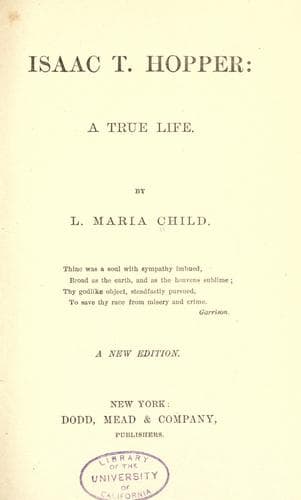
Fugitive slaves -- United States; Hopper, Isaac T. (Isaac Tatem), 1771-1852
As early as 1806, James Lindley, of Pennsylvania, had a large piece of
iron hurled at him, as he was passing through the streets, at Havre de
Grace, Maryland. Three of his ribs were broken, and several teeth
knocked out, and he was beaten till he was supposed to be dead. All this
was done merely because they mistook him for Jacob Lindley, the Quaker
preacher, who was well known as a friend to fugitives from slavery.
In view of these, and other similar facts, Friend Hopper was never
disposed to blame abolitionists for excitements at the South, as many of
the Quakers were inclined to do. He had a sincere respect for the
integrity and conscientious boldness of William Lloyd Garrison; as all
have, who know him well enough to appreciate his character. For many
years, he was always an invited and welcome guest on the occasion of the
annual meeting of the Anti-Slavery Society in New-York. Mr. Garrison's
feelings toward him are manifested in the following answer to one of his
letters: "As there is no one in the world for whom I entertain more
veneration and esteem than for yourself, and as there is no place in
New-York, that is so much like home to me, as your own hospitable
dwelling, be assured it will give me the utmost pleasure to accept your
friendly invitation to remain under your roof during the approaching
anniversary week." It was on one of these occasions, that Garrison
addressed to him the following sonnet:
"Thou kind and venerable friend of man,
In heart and spirit young, though old in years!
The tyrant trembles when thy name he hears,
And the slave joys thy honest face to scan.
A friend more true and brave, since time began,
Humanity has never found: her fears
By thee have been dispelled, and wiped the tears
Adown her sorrow-stricken cheeks that ran.
If like Napoleon's appears thy face,
Thy soul to his bears no similitude.
He came to curse, but thou to bless our race.
Thy hands are pure; in blood were his imbrued.
His memory shall be covered with disgrace,
But thine embalmed among the truly great and good."
Until the last few years of his life, Friend Hopper usually walked to
and from his office twice a day, making about five miles in the whole;
to which he sometimes added a walk in the evening, to visit children or
friends, or transact some necessary business. When the weather was very
unpleasant, he availed himself of the Harlem cars. Upon one of these
occasions, it chanced that the long, ponderous vehicle was nearly empty.
They had not proceeded far, when a very respectable-looking young woman
beckoned for the car to stop. It did so; but when she set her foot on
the step, the conductor, somewhat rudely pushed her back; and she
turned away, evidently much mortified. Friend Hopper started up and
inquired, "Why didst thou push that woman away?"
"She's colored," was the laconic reply.
Public-domain text, read in full here on John Shaqi.
Reviews
Reviews
No reviews yet
Be the first to share your thoughts on this work.
Elsewhere in the archive
Join the Discussion
Join the discussion
Sign in to leave a comment or review.
Sign InorCreate an account