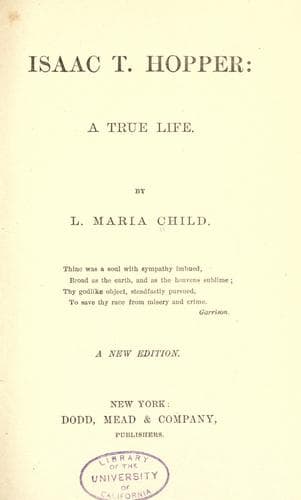
Fugitive slaves -- United States; Hopper, Isaac T. (Isaac Tatem), 1771-1852
A black man, who had fled from bondage, married a mulatto woman in
Philadelphia, and became the father of six children. He owned a small
house in the neighborhood of that city, and had lived there comfortably
several years, when that abominable law was passed, by which the
Northern States rendered their free soil a great hunting-ground for the
rich and powerful to run down the poor and weak. In rushed the
slaveholders from all quarters, to seize their helpless prey! At dead of
night, the black man, sleeping quietly in the humble home he had earned
by unremitting industry, was roused up to receive information that his
master was in pursuit of him. His eldest daughter was out at service in
the neighborhood, and there was no time to give her notice. They hastily
packed such articles as they could take, caught the little ones from
their beds, and escaped before the morning dawned. A gentleman, who saw
them next day on board a steamboat, observed their uneasiness, and
suspected they were "fugitives from injustice." When he remarked this to
a companion, he replied, "They have too much luggage to be slaves."
Nevertheless, he thought it could do no harm to inform them that Isaac
T. Hopper of New-York was the best adviser of fugitives. Accordingly, a
few hours afterward, the whole colored colony was established in his
house; where the genteel-looking mother, and her bright, pretty little
children excited a very lively interest in all hearts. They made their
way to Canada as soon as possible, and the daughter who was left in
Philadelphia, was soon after sent to them.
Friend Hopper's resolute resistance to oppression, in every form, never
produced any harshness in his manners, or diminished his love of quiet
domestic life. He habitually surrendered himself to pleasant influences,
even from events that troubled him at the time, he generally extracted
some agreeable incident and soon forgot those of opposite character. It
was quite observable how little he thought of the instances of
ingratitude he had met with. He seldom, if ever, alluded to them, unless
reminded by some direct question; but the unfortunate beings who had
persevered in reformation, and manifested gratitude, were always
uppermost in his thoughts.
Public-domain text, read in full here on John Shaqi.
Reviews
Reviews
No reviews yet
Be the first to share your thoughts on this work.
Elsewhere in the archive
Join the Discussion
Join the discussion
Sign in to leave a comment or review.
Sign InorCreate an account