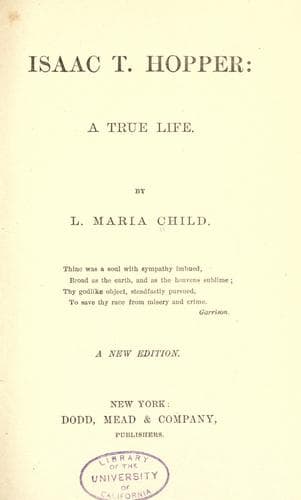
Fugitive slaves -- United States; Hopper, Isaac T. (Isaac Tatem), 1771-1852
"That this may be our happy experience, is the fervent desire of
your sincere and affectionate friend,
"ISAAC T. HOPPER.
"NEW-YORK, 4th mo. 15, 1852."
Early in the Spring, he was conveyed to the house of his daughter, Mrs.
Gibbons, in the upper part of the city; it being supposed that change of
air and scene might prove beneficial. It was afterward deemed imprudent
to remove him. His illness was attended with a good deal of physical
suffering; but he was uniformly patient and cheerful. He often observed,
"There is no cloud. There is nothing in my way. Nothing troubles me."
His daughters left all other duties, and devoted themselves exclusively
to him. Never were the declining hours of an old man watched over with
more devoted affection. Writing to his daughter Mary, he says: "I have
the best nurses in New-York, thy mother and sisters. I have every
comfort that industry and ingenuity can supply."
Among the Quakers who manifested kindness and sympathy, several belonged
to the branch called Orthodox; for a sincere respect and friendship had
grown up between him and individuals of that Society, in New-York, after
the dust of controversy had subsided. He was always glad to see them;
for his heart warmed toward the plain dress and the plain language. But
I think nothing during his illness gave him more unalloyed satisfaction
than a visit from William and Deborah Wharton, Friends from
Philadelphia. He loved this worthy couple for their truly Christian
character; and they were, moreover, endeared to him by many tender and
pleasant associations. They stood by him generously during his severe
pecuniary struggles; they had been devoted to his beloved Sarah, whose
long illness was cheered by their unremitting attentions, and she, for
many years, had received from Hannah Fisher, Deborah's mother, the most
uniform kindness. William's father, a wealthy merchant, had been to him
an early and constant friend; and his uncle, the excellent mayor of
Philadelphia, had sustained him by his influence and hearty
co-operation, in many a fugitive slave case, that occurred in years long
past. It was, therefore, altogether pleasant to clasp hands with these
tried and trusty friends, before life and all its reminiscences faded
away.
His physician, Dr. John C. Beales, was very assiduous in his attentions,
and his visits were always interesting to the invalid, who generally
made them an occasion for pleasant and animated conversation; often
leading the doctor off the professional track, by some playful account
of his symptoms, however painful they might be. He had been his medical
adviser for many years, and as a mark of respect for his disinterested
services to his fellow-men, he uniformly declined to receive any
compensation.
Public-domain text, read in full here on John Shaqi.
Reviews
Reviews
No reviews yet
Be the first to share your thoughts on this work.
Elsewhere in the archive
Join the Discussion
Join the discussion
Sign in to leave a comment or review.
Sign InorCreate an account