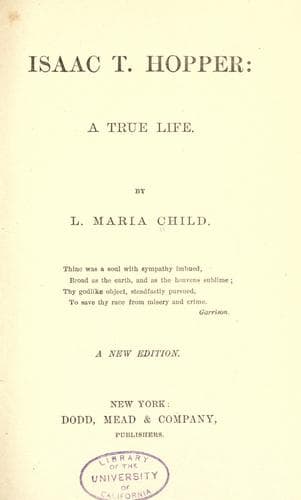
Fugitive slaves -- United States; Hopper, Isaac T. (Isaac Tatem), 1771-1852
He had risen very early, according to his usual custom, and upon opening
his front door he found a letter slipped under it, addressed to him.
This anonymous epistle informed him that eleven slaves had been
arrested, and were to be tried before Alderman Douglass that morning;
that the owners were gentlemen of wealth and high standing, and could
produce the most satisfactory evidence that the persons arrested were
their slaves; consequently Friend Hopper's attendance could be of no
possible benefit to them. It went on to say that the magistrate
understood his business, and could do justice without his assistance;
but if, notwithstanding this warning, he did attend at the magistrate's
office, for the purpose of wresting from these gentlemen their property,
his house would be burned while himself and family were asleep in it,
and his life would certainly be taken. The writer invoked the most awful
imprecations upon himself if he did not carry these threats into
execution.
Friend Hopper was too much accustomed to such epistles to be disturbed
by them. He put it in his pocket, and said nothing about it, lest his
wife should be alarmed. A few minutes afterward, he received a message
from some colored people begging him to go to the assistance of the
fugitives; and when the trial came on, he was at the alderman's office,
of course. Richard Rush was counsel for the claimants. The colored
prisoners had no lawyer. This examination was carried on with much
earnestness and excitement. One of the Virginians failed in proof as to
the identity of the person he claimed. In the case of several others,
the power of attorney was pronounced informal by the magistrate. After a
long protracted controversy, during which Friend Hopper threw as many
difficulties in the way as possible, it was decided that four of the
persons in custody were proved to be slaves, and the other seven were
discharged. This decision greatly exasperated the Southerners, and they
vented their anger in very violent expressions. The constables employed
were unprincipled men, ready for any low business, provided it were
profitable. The man-hunters had engaged to give them fifty dollars for
each slave they were enabled to take back to Virginia; but they were to
receive nothing for those who were discharged. Hence, their extreme
anxiety to avoid Friend Hopper's interference. When they found that more
than half of their destined prey had slipped through their fingers, they
were furious. One of them especially raved like a madman. He had written
the anonymous letter, and was truly "a lewd fellow of the baser sort."
Public-domain text, read in full here on John Shaqi.
Reviews
Reviews
No reviews yet
Be the first to share your thoughts on this work.
Elsewhere in the archive
Join the Discussion
Join the discussion
Sign in to leave a comment or review.
Sign InorCreate an account