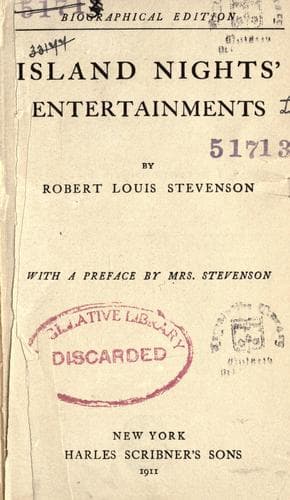
Island Nights' EntertainmentsStevenson, Robert Louis
General
Island Nights' Entertainments
Stevenson, Robert Louis
Islands of the Pacific -- Fiction; Short stories
“Very well,” replied Keawe. “I have a curiosity myself. So come, let us
have one look at you, Mr. Imp.”
Now as soon as that was said, the imp looked out of the bottle, and in
again, swift as a lizard; and there sat Keawe and Lopaka turned to
stone. The night had quite come, before either found a thought to say
or voice to say it with; and then Lopaka pushed the money over and took
the bottle.
“I am a man of my word,” said he, “and had need to be so, or I would
not touch this bottle with my foot. Well, I shall get my schooner and a
dollar or two for my pocket; and then I will be rid of this devil as
fast as I can. For to tell you the plain truth, the look of him has
cast me down.”
“Lopaka,” said Keawe, “do not you think any worse of me than you can
help; I know it is night, and the roads bad, and the pass by the tombs
an ill place to go by so late, but I declare since I have seen that
little face, I cannot eat or sleep or pray till it is gone from me. I
will give you a lantern and a basket to put the bottle in, and any
picture or fine thing in all my house that takes your fancy;—and be
gone at once, and go sleep at Hookena with Nahinu.”
“Keawe,” said Lopaka, “many a man would take this ill; above all, when
I am doing you a turn so friendly, as to keep my word and buy the
bottle; and for that matter, the night and the dark, and the way by the
tombs, must be all tenfold more dangerous to a man with such a sin upon
his conscience, and such a bottle under his arm. But for my part, I am
so extremely terrified myself, I have not the heart to blame you. Here
I go then; and I pray God you may be happy in your house, and I
fortunate with my schooner, and both get to heaven in the end in spite
of the devil and his bottle.”
So Lopaka went down the mountain; and Keawe stood in his front balcony,
and listened to the clink of the horse’s shoes, and watched the lantern
go shining down the path, and along the cliff of caves where the old
dead are buried; and all the time he trembled and clasped his hands,
and prayed for his friend, and gave glory to God that he himself was
escaped out of that trouble.
But the next day came very brightly, and that new house of his was so
delightful to behold that he forgot his terrors. One day followed
another, and Keawe dwelt there in perpetual joy. He had his place on
the back porch; it was there he ate and lived, and read the stories in
the Honolulu newspapers; but when anyone came by they would go in and
view the chambers and the pictures. And the fame of the house went far
and wide; it was called _Ka-Hale Nui_—the Great House—in all Kona; and
sometimes the Bright House, for Keawe kept a Chinaman, who was all day
dusting and furbishing; and the glass, and the gilt, and the fine
stuffs, and the pictures, shone as bright as the morning. As for Keawe
himself, he could not walk in the chambers without singing, his heart
was so enlarged; and when ships sailed by upon the sea, he would fly
his colours on the mast.
Public-domain text, read in full here on John Shaqi.
Reviews
Reviews
No reviews yet
Be the first to share your thoughts on this work.
Elsewhere in the archive
Join the Discussion
Join the discussion
Sign in to leave a comment or review.
Sign InorCreate an account