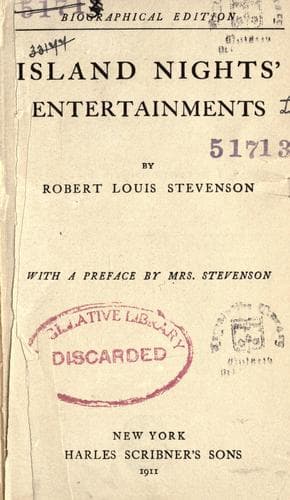
Island Nights' EntertainmentsStevenson, Robert Louis
General
Island Nights' Entertainments
Stevenson, Robert Louis
Islands of the Pacific -- Fiction; Short stories
“Kokua,” said he, “you made a mock of me all the evening; and it is
still time to bid me go. I would not tell you who I was, because I have
so fine a house, and I feared you would think too much of that house
and too little of the man that loves you. Now you know all, and if you
wish to have seen the last of me, say so at once.”
“No,” said Kokua; but this time she did not laugh, nor did Keawe ask
for more.
This was the wooing of Keawe; things had gone quickly; but so an arrow
goes, and the ball of a rifle swifter still, and yet both may strike
the target. Things had gone fast, but they had gone far also, and the
thought of Keawe rang in the maiden’s head; she heard his voice in the
breach of the surf upon the lava, and for this young man that she had
seen but twice she would have left father and mother and her native
islands. As for Keawe himself, his horse flew up the path of the
mountain under the cliff of tombs, and the sound of the hoofs, and the
sound of Keawe singing to himself for pleasure, echoed in the caverns
of the dead. He came to the Bright House, and still he was singing. He
sat and ate in the broad balcony, and the Chinaman wondered at his
master, to hear how he sang between the mouthfuls. The sun went down
into the sea, and the night came; and Keawe walked the balconies by
lamplight, high on the mountains, and the voice of his singing startled
men on ships.
“Here am I now upon my high place,” he said to himself. “Life may be no
better; this is the mountain top; and all shelves about me toward the
worse. For the first time I will light up the chambers, and bathe in my
fine bath with the hot water and the cold, and sleep alone in the bed
of my bridal chamber.”
So the Chinaman had word, and he must rise from sleep and light the
furnaces; and as he wrought below, beside the boilers, he heard his
master singing and rejoicing above him in the lighted chambers. When
the water began to be hot the Chinaman cried to his master; and Keawe
went into the bathroom; and the Chinaman heard him sing as he filled
the marble basin; and heard him sing, and the singing broken, as he
undressed; until of a sudden, the song ceased. The Chinaman listened,
and listened; he called up the house to Keawe to ask if all were well,
and Keawe answered him “Yes,” and bade him go to bed; but there was no
more singing in the Bright House; and all night long, the Chinaman
heard his master’s feet go round and round the balconies without
repose.
Now the truth of it was this: as Keawe undressed for his bath, he spied
upon his flesh a patch like a patch of lichen on a rock, and it was
then that he stopped singing. For he knew the likeness of that patch,
and knew that he was fallen in the Chinese Evil. [5]
Public-domain text, read in full here on John Shaqi.
Reviews
Reviews
No reviews yet
Be the first to share your thoughts on this work.
Elsewhere in the archive
Join the Discussion
Join the discussion
Sign in to leave a comment or review.
Sign InorCreate an account