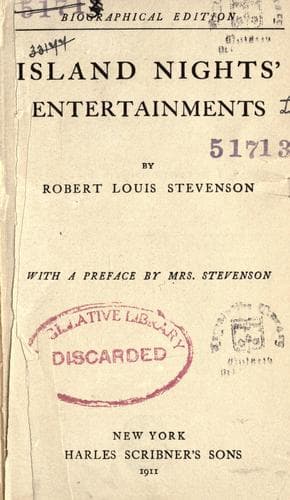
Island Nights' EntertainmentsStevenson, Robert Louis
General
Island Nights' Entertainments
Stevenson, Robert Louis
Islands of the Pacific -- Fiction; Short stories
The lawyer’s face became very dark. “I do not profess to misunderstand
you, Mr. Keawe,” said he, “though this is an ugly business to be
stirring in. You may be sure I know nothing, but yet I have a guess,
and if you would apply in a certain quarter I think you might have
news.”
And he named the name of a man, which, again, I had better not repeat.
So it was for days, and Keawe went from one to another, finding
everywhere new clothes and carriages, and fine new houses and men
everywhere in great contentment, although, to be sure, when he hinted
at his business their faces would cloud over.
“No doubt I am upon the track,” thought Keawe. “These new clothes and
carriages are all the gifts of the little imp, and these glad faces are
the faces of men who have taken their profit and got rid of the
accursed thing in safety. When I see pale cheeks and hear sighing, I
shall know that I am near the bottle.”
So it befell at last that he was recommended to a Haole in Beritania
Street. When he came to the door, about the hour of the evening meal,
there were the usual marks of the new house, and the young garden, and
the electric light shining in the windows; but when the owner came, a
shock of hope and fear ran through Keawe; for here was a young man,
white as a corpse, and black about the eyes, the hair shedding from his
head, and such a look in his countenance as a man may have when he is
waiting for the gallows.
“Here it is, to be sure,” thought Keawe, and so with this man he noways
veiled his errand. “I am come to buy the bottle,” said he.
At the word, the young Haole of Beritania Street reeled against the
wall.
“The bottle!” he gasped. “To buy the bottle!” Then he seemed to choke,
and seizing Keawe by the arm carried him into a room and poured out
wine in two glasses.
“Here is my respects,” said Keawe, who had been much about with Haoles
in his time. “Yes,” he added, “I am come to buy the bottle. What is the
price by now?”
At that word the young man let his glass slip through his fingers, and
looked upon Keawe like a ghost.
“The price,” says he; “the price! You do not know the price?”
“It is for that I am asking you,” returned Keawe. “But why are you so
much concerned? Is there anything wrong about the price?”
“It has dropped a great deal in value since your time, Mr. Keawe,” said
the young man stammering.
“Well, well, I shall have the less to pay for it,” says Keawe. “How
much did it cost you?”
The young man was as white as a sheet. “Two cents,” said he.
“What?” cried Keawe, “two cents? Why, then, you can only sell it for
one. And he who buys it—” The words died upon Keawe’s tongue; he who
bought it could never sell it again, the bottle and the bottle imp must
abide with him until he died, and when he died must carry him to the
red end of hell.
Public-domain text, read in full here on John Shaqi.
Reviews
Reviews
No reviews yet
Be the first to share your thoughts on this work.
Elsewhere in the archive
Join the Discussion
Join the discussion
Sign in to leave a comment or review.
Sign InorCreate an account