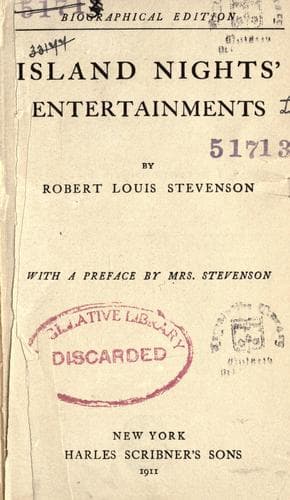
Island Nights' EntertainmentsStevenson, Robert Louis
General
Island Nights' Entertainments
Stevenson, Robert Louis
Islands of the Pacific -- Fiction; Short stories
Now it was so with these two, that when they were together, Keawe’s
heart was stilled; but so soon as he was alone he fell into a brooding
horror, and heard the flames crackle, and saw the red fire burn in the
bottomless pit. The girl, indeed, had come to him wholly; her heart
leapt in her side at sight of him, her hand clung to his; and she was
so fashioned from the hair upon her head to the nails upon her toes
that none could see her without joy. She was pleasant in her nature.
She had the good word always. Full of song she was, and went to and fro
in the Bright House, the brightest thing in its three storeys,
carolling like the birds. And Keawe beheld and heard her with delight,
and then must shrink upon one side, and weep and groan to think upon
the price that he had paid for her; and then he must dry his eyes, and
wash his face, and go and sit with her on the broad balconies, joining
in her songs, and, with a sick spirit, answering her smiles.
There came a day when her feet began to be heavy and her songs more
rare; and now it was not Keawe only that would weep apart, but each
would sunder from the other and sit in opposite balconies with the
whole width of the Bright House betwixt. Keawe was so sunk in his
despair, he scarce observed the change, and was only glad he had more
hours to sit alone and brood upon his destiny, and was not so
frequently condemned to pull a smiling face on a sick heart. But one
day, coming softly through the house, he heard the sound of a child
sobbing, and there was Kokua rolling her face upon the balcony floor,
and weeping like the lost.
“You do well to weep in this house, Kokua,” he said. “And yet I would
give the head off my body that you (at least) might have been happy.”
“Happy!” she cried. “Keawe, when you lived alone in your Bright House,
you were the word of the island for a happy man; laughter and song were
in your mouth, and your face was as bright as the sunrise. Then you
wedded poor Kokua; and the good God knows what is amiss in her—but from
that day you have not smiled. Oh!” she cried, “what ails me? I thought
I was pretty, and I knew I loved him. What ails me that I throw this
cloud upon my husband?”
“Poor Kokua,” said Keawe. He sat down by her side, and sought to take
her hand; but that she plucked away. “Poor Kokua,” he said, again. “My
poor child—my pretty. And I had thought all this while to spare you!
Well, you shall know all. Then, at least, you will pity poor Keawe;
then you will understand how much he loved you in the past—that he
dared hell for your possession—and how much he loves you still (the
poor condemned one), that he can yet call up a smile when he beholds
you.”
With that, he told her all, even from the beginning.
“You have done this for me?” she cried “Ah, well, then what do I
care!”—and she clasped and wept upon him.
“Ah, child!” said Keawe, “and yet, when I consider of the fire of hell,
I care a good deal!”
Public-domain text, read in full here on John Shaqi.
Reviews
Reviews
No reviews yet
Be the first to share your thoughts on this work.
Elsewhere in the archive
Join the Discussion
Join the discussion
Sign in to leave a comment or review.
Sign InorCreate an account