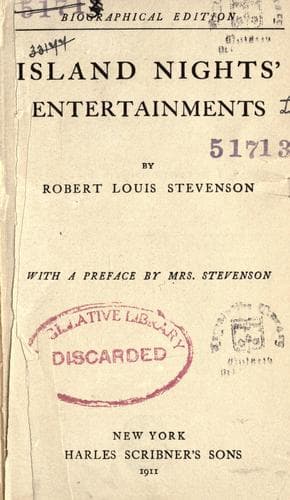
Island Nights' EntertainmentsStevenson, Robert Louis
General
Island Nights' Entertainments
Stevenson, Robert Louis
Islands of the Pacific -- Fiction; Short stories
Depression fell upon their spirits. They would sit at night in their
new house, after a day’s weariness, and not exchange one word, or the
silence would be broken by Kokua bursting suddenly into sobs. Sometimes
they would pray together; sometimes they would have the bottle out upon
the floor, and sit all evening watching how the shadow hovered in the
midst. At such times they would be afraid to go to rest. It was long
ere slumber came to them, and, if either dozed off, it would be to wake
and find the other silently weeping in the dark, or, perhaps, to wake
alone, the other having fled from the house and the neighbourhood of
that bottle, to pace under the bananas in the little garden, or to
wander on the beach by moonlight.
One night it was so when Kokua awoke. Keawe was gone. She felt in the
bed and his place was cold. Then fear fell upon her, and she sat up in
bed. A little moonshine filtered through the shutters. The room was
bright, and she could spy the bottle on the floor. Outside it blew
high, the great trees of the avenue cried aloud, and the fallen leaves
rattled in the verandah. In the midst of this Kokua was aware of
another sound; whether of a beast or of a man she could scarce tell,
but it was as sad as death, and cut her to the soul. Softly she arose,
set the door ajar, and looked forth into the moonlit yard. There, under
the bananas, lay Keawe, his mouth in the dust, and as he lay he moaned.
It was Kokua’s first thought to run forward and console him; her second
potently withheld her. Keawe had borne himself before his wife like a
brave man; it became her little in the hour of weakness to intrude upon
his shame. With the thought she drew back into the house.
“Heaven!” she thought, “how careless have I been—how weak! It is he,
not I, that stands in this eternal peril; it was he, not I, that took
the curse upon his soul. It is for my sake, and for the love of a
creature of so little worth and such poor help, that he now beholds so
close to him the flames of hell—ay, and smells the smoke of it, lying
without there in the wind and moonlight. Am I so dull of spirit that
never till now I have surmised my duty, or have I seen it before and
turned aside? But now, at least, I take up my soul in both the hands of
my affection; now I say farewell to the white steps of heaven and the
waiting faces of my friends. A love for a love, and let mine be
equalled with Keawe’s! A soul for a soul, and be it mine to perish!”
She was a deft woman with her hands, and was soon apparelled. She took
in her hands the change—the precious centimes they kept ever at their
side; for this coin is little used, and they had made provision at a
Government office. When she was forth in the avenue clouds came on the
wind, and the moon was blackened. The town slept, and she knew not
whither to turn till she heard one coughing in the shadow of the trees.
“Old man,” said Kokua, “what do you here abroad in the cold night?”
Public-domain text, read in full here on John Shaqi.
Reviews
Reviews
No reviews yet
Be the first to share your thoughts on this work.
Elsewhere in the archive
Join the Discussion
Join the discussion
Sign in to leave a comment or review.
Sign InorCreate an account