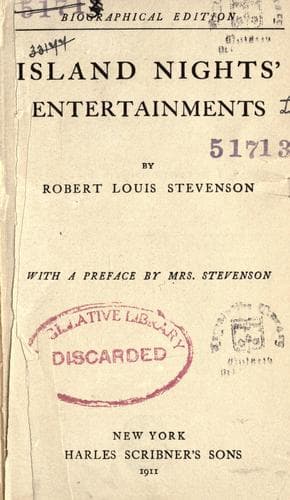
Island Nights' EntertainmentsStevenson, Robert Louis
General
Island Nights' Entertainments
Stevenson, Robert Louis
Islands of the Pacific -- Fiction; Short stories
Kokua concealed the bottle under her holoku, said farewell to the old
man, and walked off along the avenue, she cared not whither. For all
roads were now the same to her, and led equally to hell. Sometimes she
walked, and sometimes ran; sometimes she screamed out loud in the
night, and sometimes lay by the wayside in the dust and wept. All that
she had heard of hell came back to her; she saw the flames blaze, and
she smelt the smoke, and her flesh withered on the coals.
Near day she came to her mind again, and returned to the house. It was
even as the old man said—Keawe slumbered like a child. Kokua stood and
gazed upon his face.
“Now, my husband,” said she, “it is your turn to sleep. When you wake
it will be your turn to sing and laugh. But for poor Kokua, alas! that
meant no evil—for poor Kokua no more sleep, no more singing, no more
delight, whether in earth or heaven.”
With that she lay down in the bed by his side, and her misery was so
extreme that she fell in a deep slumber instantly.
Late in the morning her husband woke her and gave her the good news. It
seemed he was silly with delight, for he paid no heed to her distress,
ill though she dissembled it. The words stuck in her mouth, it mattered
not; Keawe did the speaking. She ate not a bite, but who was to observe
it? for Keawe cleared the dish. Kokua saw and heard him, like some
strange thing in a dream; there were times when she forgot or doubted,
and put her hands to her brow; to know herself doomed and hear her
husband babble, seemed so monstrous.
All the while Keawe was eating and talking, and planning the time of
their return, and thanking her for saving him, and fondling her, and
calling her the true helper after all. He laughed at the old man that
was fool enough to buy that bottle.
“A worthy old man he seemed,” Keawe said. “But no one can judge by
appearances. For why did the old reprobate require the bottle?”
“My husband,” said Kokua, humbly, “his purpose may have been good.”
Keawe laughed like an angry man.
“Fiddle-de-dee!” cried Keawe. “An old rogue, I tell you; and an old ass
to boot. For the bottle was hard enough to sell at four centimes; and
at three it will be quite impossible. The margin is not broad enough,
the thing begins to smell of scorching—brrr!” said he, and shuddered.
“It is true I bought it myself at a cent, when I knew not there were
smaller coins. I was a fool for my pains; there will never be found
another: and whoever has that bottle now will carry it to the pit.”
“O my husband!” said Kokua. “Is it not a terrible thing to save oneself
by the eternal ruin of another? It seems to me I could not laugh. I
would be humbled. I would be filled with melancholy. I would pray for
the poor holder.”
Then Keawe, because he felt the truth of what she said, grew the more
angry. “Heighty-teighty!” cried he. “You may be filled with melancholy
if you please. It is not the mind of a good wife. If you thought at all
of me, you would sit shamed.”
Public-domain text, read in full here on John Shaqi.
Reviews
Reviews
No reviews yet
Be the first to share your thoughts on this work.
Elsewhere in the archive
Join the Discussion
Join the discussion
Sign in to leave a comment or review.
Sign InorCreate an account