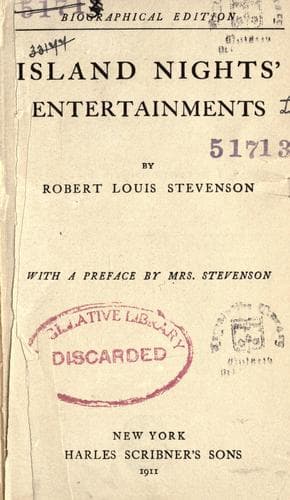
Island Nights' EntertainmentsStevenson, Robert Louis
General
Island Nights' Entertainments
Stevenson, Robert Louis
Islands of the Pacific -- Fiction; Short stories
A long time Keawe stood and looked in the doorway. At first he was
struck stupid; and then fear fell upon him that the bargain had been
made amiss, and the bottle had come back to him as it came at San
Francisco; and at that his knees were loosened, and the fumes of the
wine departed from his head like mists off a river in the morning. And
then he had another thought; and it was a strange one, that made his
cheeks to burn.
“I must make sure of this,” thought he.
So he closed the door, and went softly round the corner again, and then
came noisily in, as though he were but now returned. And, lo! by the
time he opened the front door no bottle was to be seen; and Kokua sat
in a chair and started up like one awakened out of sleep.
“I have been drinking all day and making merry,” said Keawe. “I have
been with good companions, and now I only come back for money, and
return to drink and carouse with them again.”
Both his face and voice were as stern as judgment, but Kokua was too
troubled to observe.
“You do well to use your own, my husband,” said she, and her words
trembled.
“O, I do well in all things,” said Keawe, and he went straight to the
chest and took out money. But he looked besides in the corner where
they kept the bottle, and there was no bottle there.
At that the chest heaved upon the floor like a sea-billow, and the
house span about him like a wreath of smoke, for he saw he was lost
now, and there was no escape. “It is what I feared,” he thought. “It is
she who has bought it.”
And then he came to himself a little and rose up; but the sweat
streamed on his face as thick as the rain and as cold as the
well-water.
“Kokua,” said he, “I said to you to-day what ill became me. Now I
return to carouse with my jolly companions,” and at that he laughed a
little quietly. “I will take more pleasure in the cup if you forgive
me.”
She clasped his knees in a moment; she kissed his knees with flowing
tears.
“O,” she cried, “I asked but a kind word!”
“Let us never one think hardly of the other,” said Keawe, and was gone
out of the house.
Now, the money that Keawe had taken was only some of that store of
centime pieces they had laid in at their arrival. It was very sure he
had no mind to be drinking. His wife had given her soul for him, now he
must give his for hers; no other thought was in the world with him.
At the corner, by the old calaboose, there was the boatswain waiting.
“My wife has the bottle,” said Keawe, “and, unless you help me to
recover it, there can be no more money and no more liquor to-night.”
“You do not mean to say you are serious about that bottle?” cried the
boatswain.
“There is the lamp,” said Keawe. “Do I look as if I was jesting?”
“That is so,” said the boatswain. “You look as serious as a ghost.”
Public-domain text, read in full here on John Shaqi.
Reviews
Reviews
No reviews yet
Be the first to share your thoughts on this work.
Elsewhere in the archive
Join the Discussion
Join the discussion
Sign in to leave a comment or review.
Sign InorCreate an account